AI Model Detects Solar Storm Precursors More Than Nine Hours in Advance
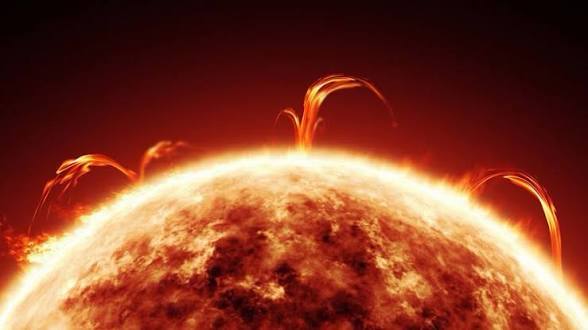
Researchers at the New Jersey Institute of Technology have developed an artificial intelligence tool that can identify the hidden warning signs of solar storms nearly nine hours before they become visible on the Sun. The model, named EarlyDetect, could change how space weather is forecast, offering earlier preparation for events that can disrupt communication satellites and ground stations.
Space weather, though best known for producing auroras at northern and southern latitudes, can also carry damaging effects for everyday systems. The central challenge that has long confronted researchers is the ability to forecast incoming space weather so that its impacts can be anticipated. EarlyDetect is designed to observe the Sun's surface and magnetic field with the goal of detecting precursor signals on active regions, where space weather activity has been found to originate.
The findings were recently published in the Journal of Geophysical Research: Machine Learning and Computation. EarlyDetect is built using Transformer architecture, the same AI framework that powers large language models such as ChatGPT and Gemini. To test the model, researchers used data previously obtained by the Helioseismic and Magnetic Imager onboard NASA's Solar Dynamics Observatory, known as SDO/HMI. EarlyDetect was trained on that data and then set to observe active regions it had not analyzed during training. The team found the model could detect precursor signals where active regions would eventually become visible with space weather activity at an average of 9.24 hours before such an event.
Dr. Alexander Kosovichev, a Distinguished Professor in the Department of Physics at NJIT, co-principal investigator, and co-author of the study, described the difficulty of the task. "The main difficulty is that an active region begins developing beneath the Sun's visible surface, where we cannot directly observe the magnetic structure," he said. "Instead, we're looking for very small changes in the magnetic field and in the pattern of acoustic waves continually traveling through the Sun. It's more like detecting a slight change in rhythm within a very noisy orchestra."
Dr. Mengjia Xu, an assistant professor of data science at NJIT, principal investigator of the project, and co-author of the study, pointed to the novelty of the approach. "Machine learning hasn't been widely applied to solar activity forecasting yet," she said. "Our work shows that advanced machine learning models can open new possibilities for future space weather prediction."
The researchers noted the historical stakes of severe space weather. The Carrington Event, which occurred from September 1 to 2, 1859, produced auroras visible worldwide and caused global telegraph networks to fail. Teleoperators received electric shocks, telegraph machines continued operating after their power had been disconnected, and telegraph paper caught fire. The event is named for British astronomer Richard Carrington, who discovered the solar flare that caused it on the morning of September 1. The intensity of the flares was later described as equivalent to 10 billion atomic bombs, wreaking global havoc only hours after they were observed.
According to the researchers, EarlyDetect demonstrates that advanced machine learning models can open new possibilities for future space weather prediction, an area where such methods have not been widely applied.
How EarlyDetect will help forecast space weather in the coming years and decades remains to be seen, and its role in operational forecasting is still to be determined.