Beyond Reach Unveils Flarewing Deployable Structures for High-Power Small Satellites
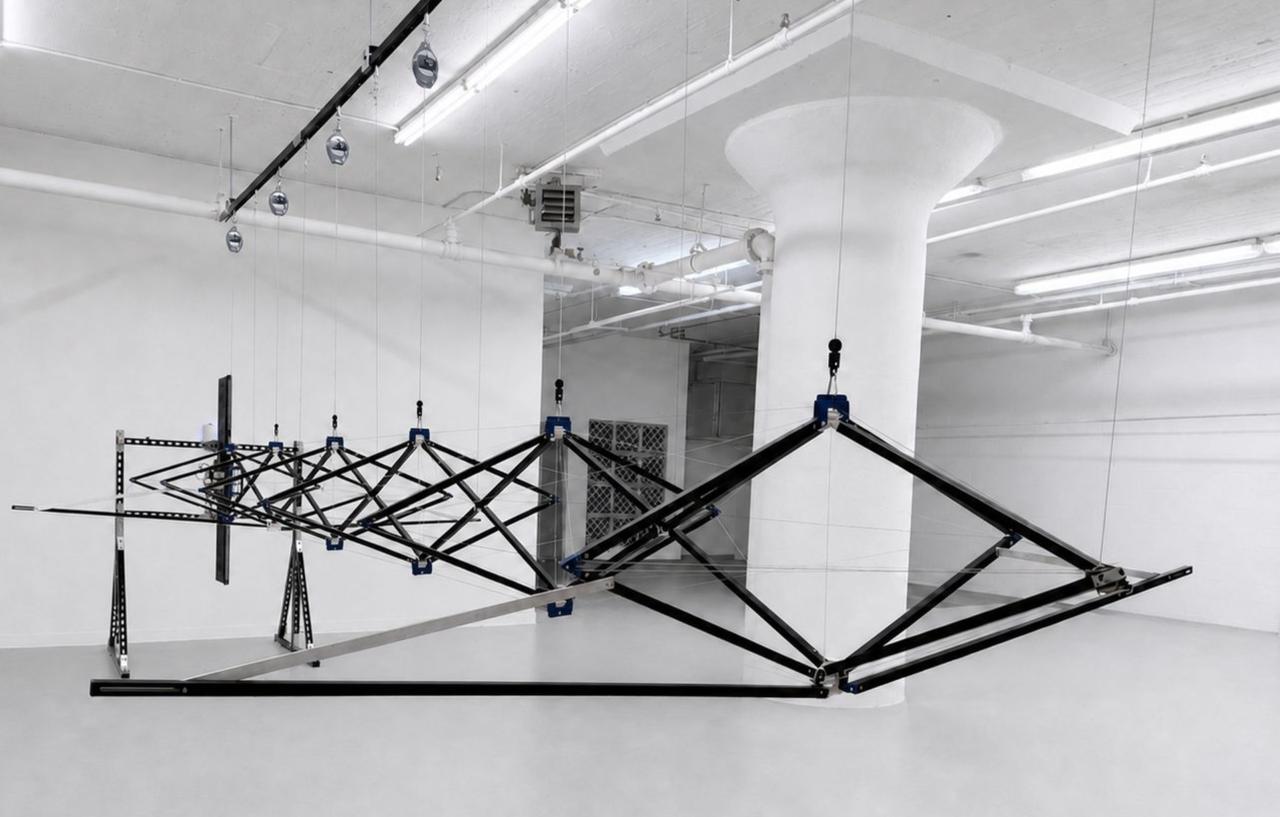
Beyond Reach Technologies on Aug. 24 announced Flarewing, a line of rigid deployable structures designed to let small satellites carry large solar arrays that stow tightly for launch. The company says the technology could enable spacecraft to generate as much as 200 kilowatts of power.
The concept traces back to a NASA Innovative Advanced Concepts study that co-founder and Chief Executive Mitch Fogelson worked on as a graduate student at Carnegie Mellon University. That study examined how to deploy kilometer-scale structures on a single launch and led to a truss design that stows flat but pops up into a triangular shape when deployed. Co-founder and Chief Technology Officer Pele Collins said the deployed structure grows stiffer as it extends, reducing bending modes that can affect pointing accuracy and maneuvers.
Flarewing comes in three configurations. The smallest, the Flarewing-S, measures 1 by 0.25 by 0.08 meters when stowed but deploys to a surface area of 30 square meters, providing between five and eight kilowatts of power depending on the solar cells used. The largest, the Flarewing-L, measures 6 by 0.29 by 0.13 meters stowed and deploys to 625 square meters, generating up to 200 kilowatts.
The structures do not require composite materials and can be made of aluminum and what Fogelson described as a variety of novel joints. He said the design supports manufacturing at scale to serve the hundreds of thousands of satellites some companies are proposing over the next five years. Collins said the deployables also fit changing satellite designs as companies optimize for SpaceX's Starship and its slot-shaped payload dispenser, moving from building giant boxes toward a Starlink-style form.
Beyond Reach went through the Y Combinator accelerator program earlier this year and generated $350 million in letters of intent for using its structures for power generation and heat dissipation. Fogelson said interest spanned orbital data centers, commercial space stations, in-space manufacturing, and satellite defense. The company, focusing for now on deployable structures for solar arrays, has two contracts with undisclosed customers conducting deeper investigations into the technology. It has raised a little more than $11 million to date, including a $10 million seed round announced in July.
The company employs 14 people in a 16,000-square-foot facility at Industry City in Brooklyn, New York. Fogelson said the decision to locate in New York reflects strong opinions about bringing aerospace to the Northeast and building a new aerospace hub in the region. Fogelson and Collins met as undergraduates at the University of Pennsylvania, and Collins worked at SpaceX for seven years on the Dragon spacecraft's parachute system before co-founding the company. Collins said engineers who study aerospace in the Northeast often have to move west to find jobs, and basing the company in Brooklyn is a deliberate effort to let them stay.
Beyond Reach frames Flarewing as a way to give small satellites access to large amounts of power in orbit, with the founders positioning the technology to support proposed large satellite constellations and applications ranging from orbital data centers to in-space manufacturing. Collins said New York City is the right place for building the biggest structures.
The company said it is focusing for now on deployable structures for solar arrays and is working through two contracts with undisclosed customers on deeper investigations into the technology. The founders described Industry City as offering room for significant expansion as the company grows.