First Supercomputer Bound for the Moon Aboard Astrolab's FLIP Rover
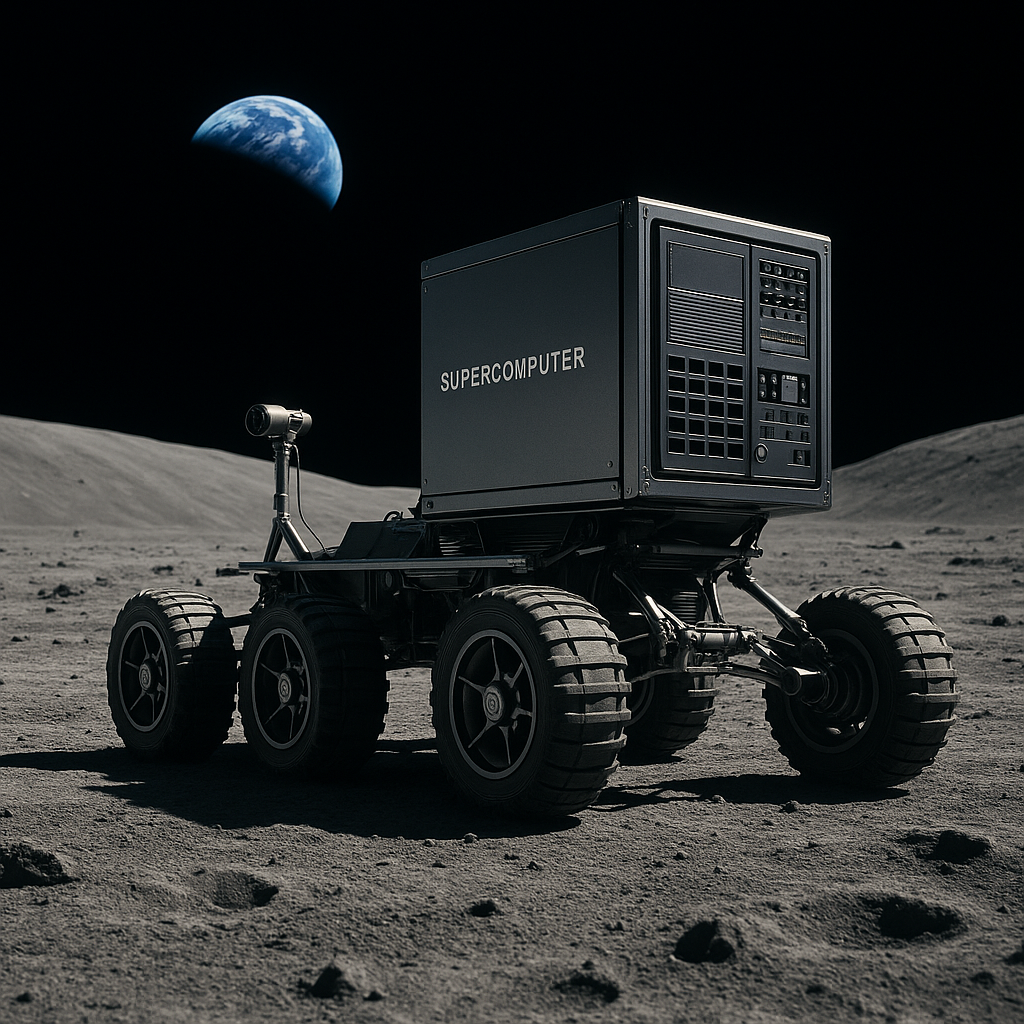
Astrolab will launch its uncrewed FLIP rover to the lunar south pole later this year carrying Hewlett Packard Enterprise's Spaceborne Computer-4, marking the first test of high-performance computing and artificial intelligence on the moon's surface. The flight, part of the Griffin Mission 1, aims to prove that advanced computing can operate in the extreme lunar environment to support future human habitation and economic activity.
Astrolab is one of two companies NASA has selected to develop a drivable rover for the Artemis program. As NASA moves closer to returning humans to the moon, the mission seeks to demonstrate capabilities that could support future crewed operations, though exactly how astronauts might use these tools, especially AI, has not yet been determined.
The Spaceborne Computer-4 is lightweight, compact, self-contained and fanless, built with heat-conductive aluminum and designed for the specific conditions of the lunar south pole. It carries a low-power 64-bit CPU paired with a GPU and will be attached to FLIP's cooling system, powered by batteries and solar cells on the rover. The computer will be paired with solid state drives from KIOXIA for memory storage. "We're sending the first supercomputer from HPE to the lunar surface later this year, doing the first GPU on the moon and the first AI experiments on the moon," said Jaret Matthews, founder and CEO of Astrolab, at an October 14 media event at the company's Hawthorne, California headquarters.
NASA has set a demanding requirement for the mission. "We have to design for a full year on the lunar surface," Matthews said. "So that means surviving multiple lunar nights, upwards of 150 hours of complete darkness where we're not receiving energy or warmth from the sun." He added that the rover must operate semi-autonomously while astronauts are not present, traveling hundreds of kilometers over many months. The computer will analyze visual data, enable autonomous observations, and process navigation, mapping and terrain analysis. HPE stated that "an AI services container will demonstrate reliable deployment of scalable AI service applications on the moon."
One experiment running on the computer is a localization software package developed at NASA's Jet Propulsion Laboratory, previously used on Mars and now flying to the moon for the first time. "The challenge with the moon and Mars is that there's no GPS, so locating yourself and knowing where you are on the surface can be difficult," Matthews said. The machine learning algorithm compares a map stored in memory to local terrain, matching features to help the rover locate itself and avoid dangerous craters.
The mission demonstrates how commercial platforms can support technology development on the moon. "The moon presents a challenging environment for advanced computing, and we're pleased to provide HPE with an opportunity to demonstrate its technology on the lunar surface," Matthews said. "Our FLIP rover is designed to accommodate a variety of payloads, and this mission will demonstrate how commercial lunar mobility platforms can support technology development and scientific research."
Griffin-1 will be the first mission for the robotic Griffin lander, developed by Astrobotic, which is flying the mission for NASA under the agency's Commercial Lunar Payload Services program. In addition to FLIP, the mission will carry Astrobotic's CubeRover, the LandCam-X optical navigation system, and Nanofiche GLPH, a small archive of human history. The launch is scheduled for later this year.