Psyche Nails Mars Gravity Assist, Puts Instruments to the Test Ahead of 2029 Asteroid Arrival
NASA's Psyche spacecraft completed a successful flyby of Mars, using the planet's gravity to speed itself toward a metal-rich asteroid in the main belt. The May 15 maneuver placed the spacecraft on the trajectory needed to rendezvous with its target in the summer of 2029, while also giving mission scientists a rare chance to exercise its instruments around a well-studied planet.
The encounter served two purposes. The gravitational boost adjusted Psyche's path and increased its speed, and the well-mapped planet acted as a practice target for the tools that will eventually investigate the asteroid. Data returned after the flyby showed the instruments performed as expected and matched established knowledge about Mars, while adding several observations from the spacecraft's unusual viewing position.
Psyche passed Mars at an altitude of 2,864 miles, or 4,609 kilometers. That distance was too great for the gamma-ray and neutron spectrometer to detect gamma rays from the planet, but scientists believed it might still register escaping neutrons. "Around the time of Mars closest approach, the neutron spectrometer detected a count-rate enhancement close to what we anticipated. It was very gratifying to see," said David Lawrence, the science lead for the spectrometer at the Johns Hopkins Applied Physics Laboratory in Laurel, Maryland.
The magnetometer, operating since the 2023 launch, measured a celestial body's magnetic signature for the first time. "As the spacecraft passed close to Mars, the magnetometer saw an intense uptick in magnetic field corresponding to the bow shock region, where the solar wind slams into the planet's magnetic field," said Ben Weiss, the mission's deputy principal investigator and magnetometry lead at the Massachusetts Institute of Technology.
The multispectral imager began returning views of Mars in early May and continued through the flyby. Because the spacecraft approached at a high-phase angle, the planet first appeared as a narrow, bright crescent, then revealed wind-shaped craters, the south polar ice cap, and the double-ringed Huygens crater. The monthlong sequence was assembled into a time-lapse video. "The imager performed brilliantly, delivering some rarely seen views of the Red Planet," said Jim Bell, the imager instrument lead at Arizona State University. The cameras also picked out the Martian moons Phobos and Deimos from a great distance, a rehearsal for the search for moonlets that the mission will conduct at the asteroid.
Lindy Elkins-Tanton, the mission's principal investigator at the University of California, Berkeley, said the imager, magnetometer, and spectrometer teams all delivered strong results. "We didn't anticipate big discoveries, given how extensively the planet has been studied, but we did complement Mars science with the data we collected through Psyche's unique perspective," she said.
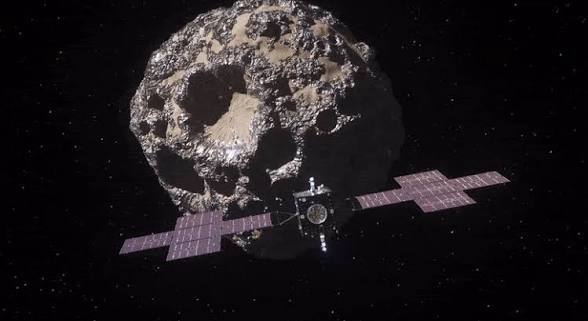
The flyby was a navigation and instrument checkout milestone, confirming that the spacecraft is healthy and performing well ahead of its 2029 arrival. The mission's target is believed to be largely made of metal and could be the exposed core of a protoplanet, one of the most scientifically unusual destinations in the solar system. When Psyche arrives, it will be the first spacecraft to orbit a world made primarily of metal.
The spacecraft is now traveling directly toward the asteroid. "The spacecraft is in great shape, and we're on schedule to resume sustained thrusting with the solar-electric propulsion system later this fall," said Bob Mase, the project manager at NASA's Jet Propulsion Laboratory in Southern California. Researchers are comparing Psyche's flyby imagery with data from other Mars missions to further calibrate the cameras before the spacecraft reaches its far less familiar target.