Astronauts Install Seventh Upgraded Solar Array, Setting Up Final ISS Power Boost
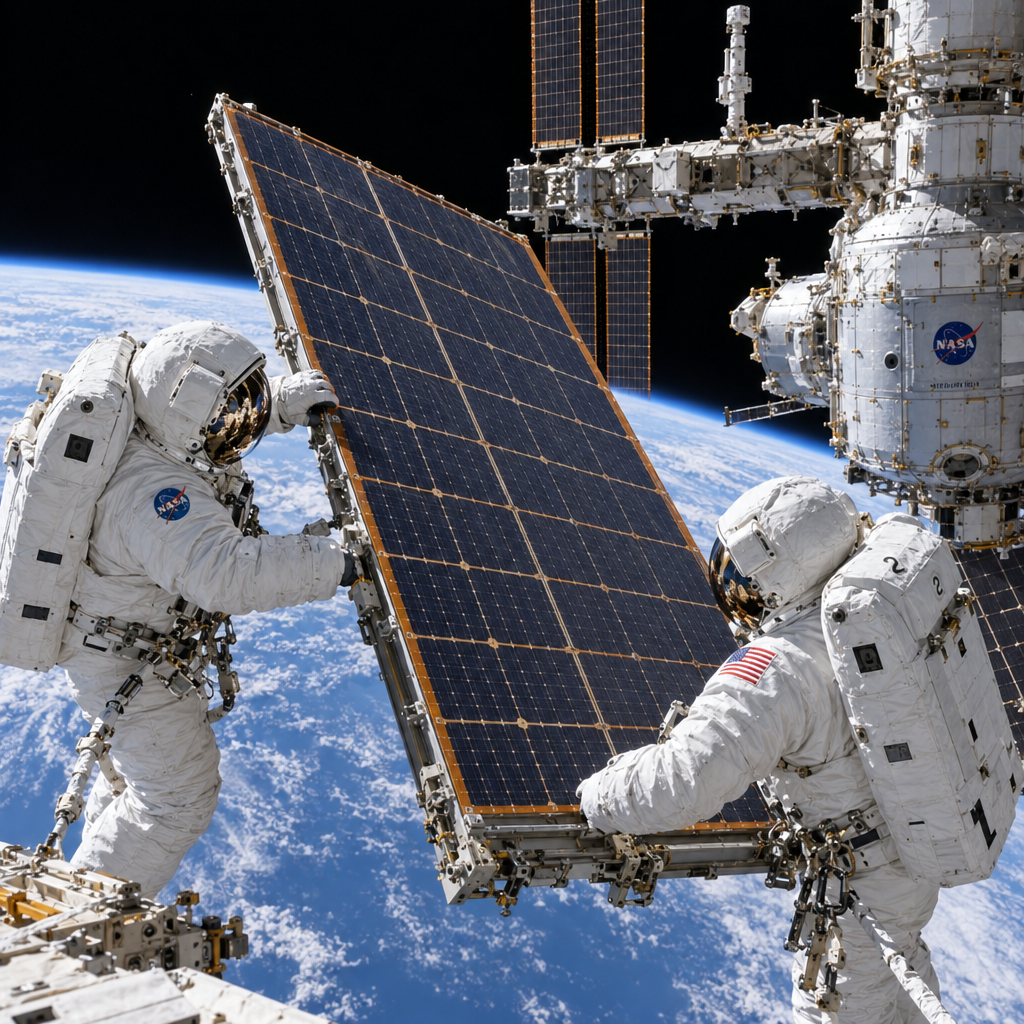
NASA astronaut Anil Menon and Canadian Space Agency astronaut Joshua Kutryk installed and unfurled the seventh of eight new roll-out solar arrays on the International Space Station during a spacewalk on October 29. The arrays are designed to power the orbiting lab through its planned retirement in 2030, and Thursday's outing was the first of two spacewalks scheduled a week apart to complete a multi-year power upgrade.
The eight IROSA arrays will raise the station's available power from 160 kilowatts to about 215 kilowatts, with each new array generating roughly 8 kilowatts. Rather than replacing the station's eight original solar wings, delivered by space shuttles between 2000 and 2009 and designed to last 15 years, NASA chose to mount the smaller IROSAs in front of the aging wings. The first IROSA unrolled in June 2021, and six were in place by 2023, when NASA ordered the seventh and eighth.
Menon, 50, and Kutryk, 44, switched their spacesuits to battery power at 7:57 a.m. EDT and began repressurizing the Quest airlock at 3:08 p.m. EDT, ending a spacewalk that lasted seven hours and 11 minutes. The pair worked far enough ahead of NASA's timeline to take on get-ahead tasks, including preparations for the final installation on November 5. Mission Control commentator Rob Navias called the spacewalk "essentially flawless." It was the 285th EVA devoted to station assembly, maintenance and upgrades.
Menon locked his boots into a foot restraint on the Canadian-built Canadarm2 and rode it to the port side of the main truss, array in hand, while Kutryk made his way along the truss. Astronauts Jessica Watkins and Luke Delaney piloted the arm from inside the station, and flight director Greg Whitney led the spacewalk from Houston. Because the array's power cables can only be connected during orbital darkness, when the station's panels are not generating electricity, mission planners timed the cable work to coincide with orbital night. The crew connected three of the four main power connectors during the first available nighttime pass, released the final restraints at 12:20 p.m. EDT, and watched the 60-foot array unfurl over about 10 minutes using energy stored in carbon-fiber composite booms. Menon made the fourth connection during the next nighttime pass.
Kutryk, who arrived at the station October 1 aboard a SpaceX Crew Dragon, became the fifth Canadian to walk in space and the first since 2019. It was Menon's fourth spacewalk, bringing his total spacewalking time to 26 hours and 31 minutes. The two final arrays arrived at the station rolled up and folded on a carrier in the trunk of a SpaceX Cargo Dragon, which launched October 13 atop a Falcon 9 from Cape Canaveral Space Force Station. Each array weighs about 750 pounds folded.
The upgrade shows NASA continuing to invest in hardware to keep the aging station fully powered even as it plans for the outpost's end of life. "Overall, these roll-out arrays increase our power generation capability up to 30 percent," said Gaurang Patel, operations integration manager for NASA's Low Earth Orbit Program. Reflecting on the work from inside the station, Menon called it "an incredible milestone."
Menon and Kutryk plan to return outside the Quest airlock November 5 to install the eighth and final IROSA at the far starboard end of the main truss, beyond the reach of the robotic arm. To cover the last stretch, the two will pass the array between foot restraints in a maneuver the team calls "the leapfrog." Garrett Hehn will serve as flight director for that spacewalk.