SpaceX AI Segment Turns EBITDA Positive Two Years Ahead of Expert Forecasts
SpaceX’s artificial intelligence business crossed a major financial milestone in the company’s first quarter as a public company, reaching positive adjusted EBITDA far earlier than at least one leading space investment firm financial model had projected.
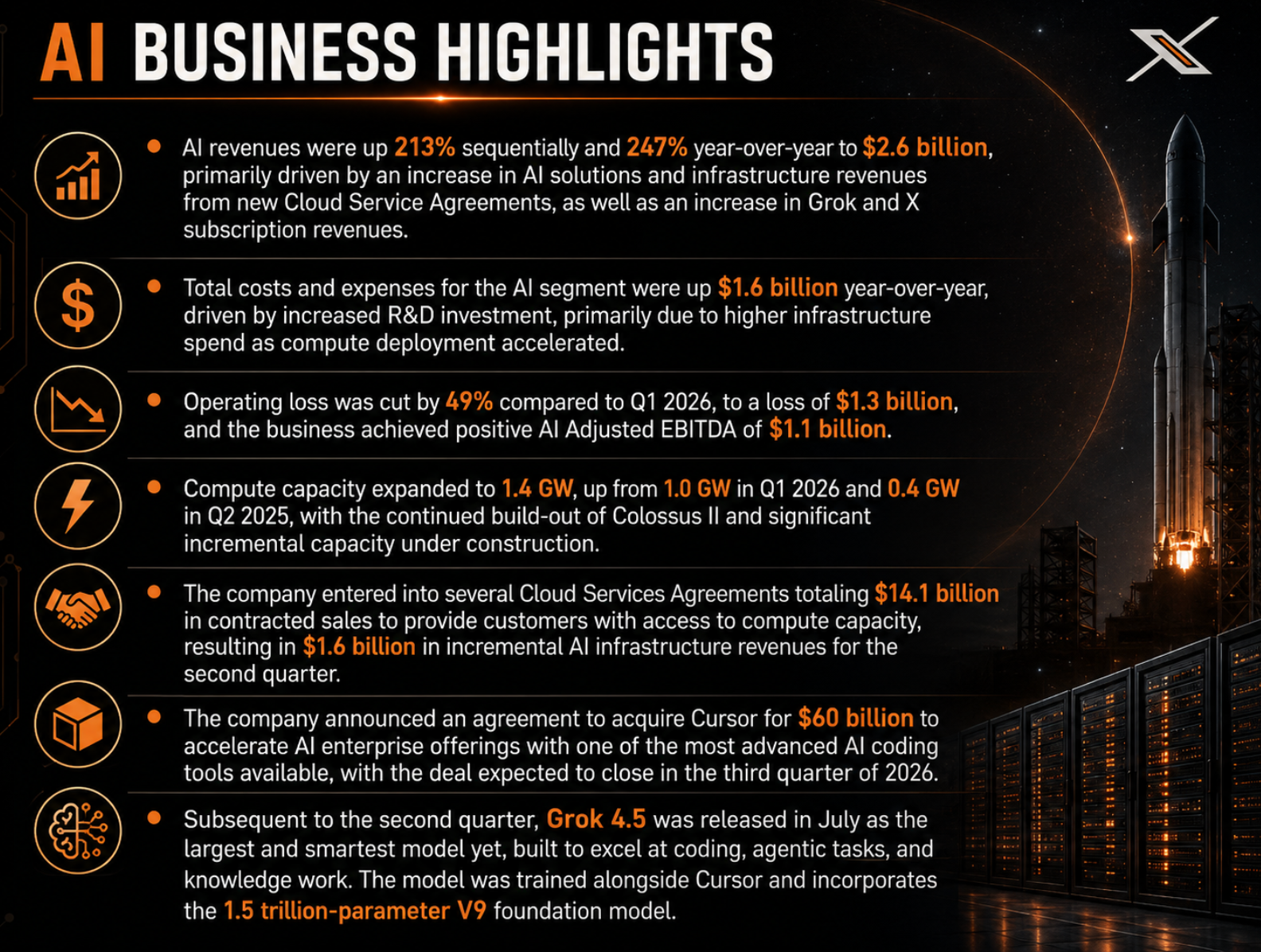
SpaceX's AI segment generated $1.15 billion in adjusted EBITDA during the second quarter of 2026, reversing a $609 million loss in the first quarter and a $276 million loss in the same period last year. The result represents a roughly $1.76 billion sequential swing in just three months. AI revenue reached $2.56 billion, up 213 percent quarter over quarter and 247 percent from a year earlier.
Space investment firm Mach33 highlighted the result in an analysis published following SpaceX’s earnings call, noting that the AI business reached positive adjusted EBITDA roughly two years ahead of its financial model. Mach33, a well regarded investment firm in the space economy and an early investor in SpaceX, has spent much of the past year modeling SpaceX’s emerging compute business alongside Starlink, launch and orbital data centers, and its work increasingly treats AI infrastructure as one of the largest potential contributors to SpaceX’s long-term valuation. The rapid improvement appears to have been driven primarily by SpaceX’s decision to monetize its rapidly expanding compute infrastructure through third-party customers such as Anthropic and Google.
SpaceX said it entered into several Cloud Services Agreements representing $14.1 billion in contracted sales. Those agreements generated approximately $1.6 billion of incremental AI infrastructure revenue during the second quarter. AI solutions and infrastructure revenue reached $2.19 billion, compared with just $475 million in the first quarter, while advertising contributed another $367 million.
At the same time, SpaceX expanded its nameplate compute capacity from 1.0 gigawatt at the end of the first quarter to 1.4 gigawatts at the end of June. A year earlier, the company operated approximately 0.4 gigawatts.
The results provide some early validation for a strategy that has increasingly transformed SpaceX from a launch and satellite communications company into a vertically integrated space, telecommunications and artificial intelligence platform.
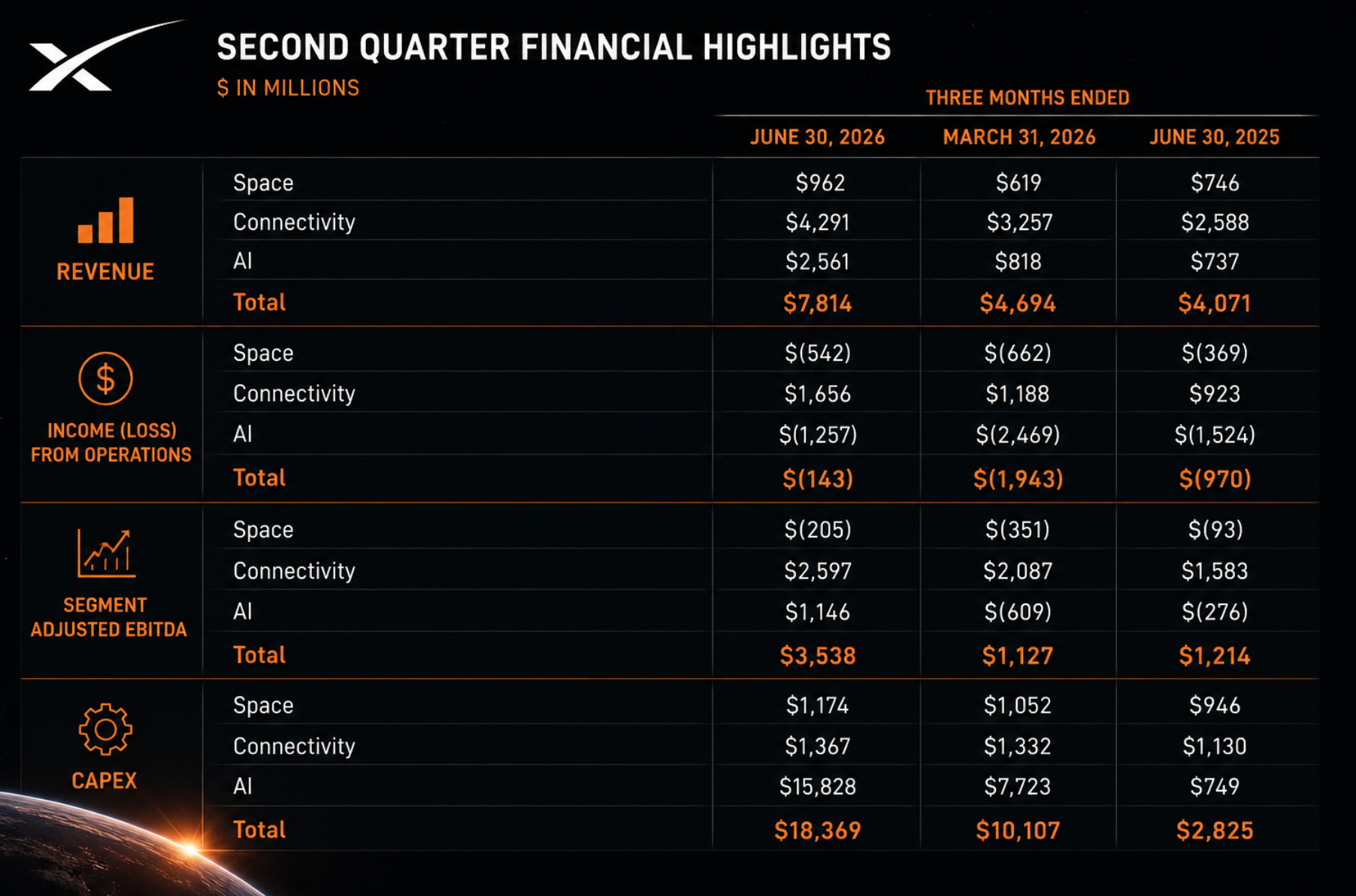
SpaceX reported total company revenue of $7.81 billion for the quarter, up 92 percent from $4.07 billion a year earlier. Adjusted EBITDA increased 191 percent to $3.54 billion, although the company still recorded a net loss of $541 million.
Starlink remains the company’s largest operating business and its primary earnings engine. The Connectivity segment generated $4.29 billion in revenue and $2.60 billion in adjusted EBITDA during the quarter. Starlink ended June with 12 million subscribers, double its subscriber base from a year earlier.
That profitability is particularly important because SpaceX is simultaneously financing two exceptionally capital-intensive development programs: artificial intelligence infrastructure and Starship. The AI milestone also requires some qualification. Positive adjusted EBITDA does not mean the segment has reached GAAP operating profitability.
SpaceX’s AI business still recorded a $1.26 billion operating loss during the quarter. The difference between that figure and its $1.15 billion adjusted EBITDA included approximately $1.89 billion of depreciation and amortization and $516 million of share-based compensation.
Capital requirements also remain enormous.
SpaceX spent $15.83 billion on AI capital expenditures during the second quarter alone, more than double the $7.72 billion invested during the first quarter and more than 20 times the $749 million spent during the second quarter of 2025. Total company capital expenditures reached $18.37 billion for the quarter.
That spending explains why investors have focused as heavily on SpaceX’s capital intensity as its rapidly improving operating results. Despite beating revenue expectations in its first public earnings report, SpaceX shares initially fell following the release as markets digested the scale of the company’s AI investment program.
SpaceX nevertheless enters the expansion with an unusually large balance sheet. The company ended the quarter with approximately $100 billion in cash, cash equivalents and marketable securities following its June IPO and subsequent $25 billion bond offering. It also reported $47.5 billion in backlog.
For the space industry, however, the significance of SpaceX’s AI economics extends beyond terrestrial data centers.
SpaceX has increasingly positioned high-density compute as a future payload for Starship. The company has outlined plans for dedicated orbital compute satellites, which will rely on falling launch costs ($/kg) from Starship, specialized AI chips, solar power, and radiative cooling to make these orbital datacenters economically competitive with terrestrial infrastructure (read our research on orbital datacenters here). In one SpaceX financial model, it's estimated that a one-gigawatt orbital compute system deployed in 2028 would cost approximately $46 billion, with costs declining as satellite manufacturing capacity increases and economies of scale are realized, and launch costs decrease.
That makes the current terrestrial AI buildout potentially important to SpaceX’s space ambitions in two ways. It creates another revenue and earnings engine capable of supporting Starship development, while simultaneously allowing SpaceX to build experience operating enormous compute clusters before attempting to move portions of that infrastructure into orbit.
The second-quarter results do not prove that orbital data centers will ultimately be economical, nor do they eliminate the enormous capital requirements associated with SpaceX’s AI expansion. They do show, however, that the company has found substantial external demand for the compute infrastructure it is aggressively building.