Amazon Leo Lands First African Consumer Broadband Deal With South Africa's Herotel

- Fast Facts:
- > Amazon Leo has signed its first African consumer broadband partnership, teaming up with South Africa's Herotel to launch the satellite internet service in 2027.
- > Herotel's existing network of 350,000 customers, 550+ towns, and 120 local offices will support installation and customer service while Amazon Leo extends broadband to rural and underserved communities.
- > Amazon Leo now has more than 390 satellites in orbit and plans to begin initial service this year across certain regions, though it remains far smaller than Starlink's constellation of more than 10,800 operational satellites.
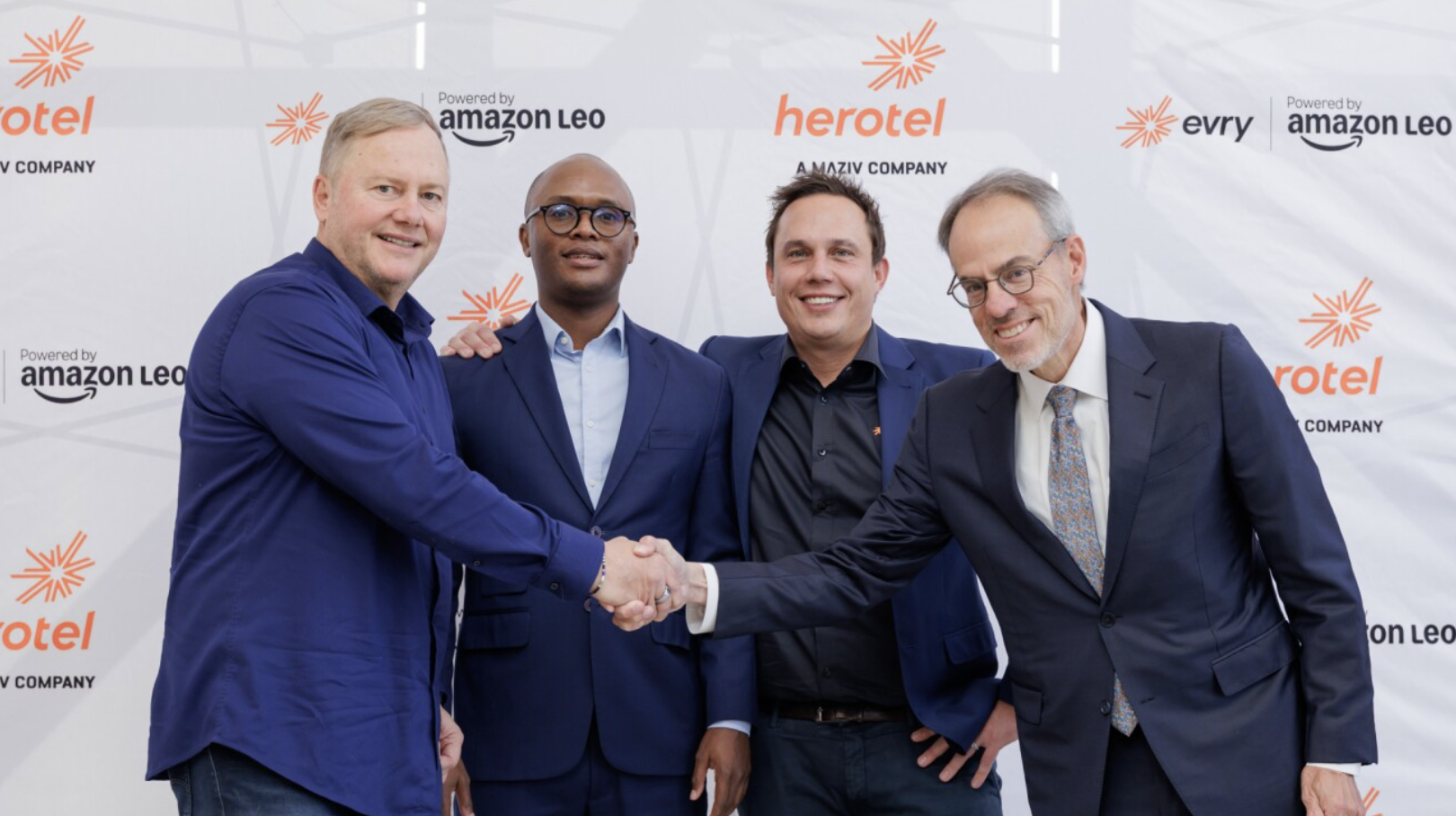
Amazon Leo has signed its first consumer broadband distribution agreement in Africa, partnering with South African internet provider Herotel to launch a satellite internet service aimed at connecting rural communities that remain beyond the reach of traditional broadband infrastructure.
The service, branded "evry" and powered by Amazon Leo's low Earth orbit satellite network, is expected to begin commercial operations in 2027. Under the agreement, Herotel will provide local installation, customer support, and field operations while leveraging Amazon Leo's satellite constellation to extend coverage into remote parts of South Africa.
The partnership marks Amazon Leo's first agreement of its kind on the African continent and represents another step in Amazon's effort to expand its satellite broadband business beyond North America and Europe.
Herotel, South Africa's largest fixed internet service provider, currently serves more than 350,000 active customers across more than 550 towns through fiber and fixed wireless networks. The company says satellite connectivity will allow it to reach homes and businesses where laying fiber or building wireless infrastructure is economically impractical.
Millions of South Africans, particularly those living on farms and in sparsely populated rural regions, continue to lack reliable internet access because of the high cost of terrestrial network deployment.
Amazon Leo satellites operate at an altitude of approximately 590 kilometers, significantly closer to Earth than traditional geostationary communications satellites located roughly 35,786 kilometers above the planet. The lower orbit reduces signal latency, making applications such as video conferencing, streaming, online education, and remote work more practical.
Customers will connect through compact user terminals without requiring fiber or fixed wireless infrastructure at their property.
"Amazon Leo and Herotel share the same mission to empower all South Africans through access to high-speed internet," said David Zapolsky, Amazon's Chief Global Affairs and Legal Officer. "This collaboration is about breaking down barriers and unlocking opportunity for millions of people who don't yet have reliable access."
Herotel CEO Van Zyl Botha said the partnership allows the company to reach customers beyond the limits of its existing terrestrial network.
"We have always believed that South Africans outside the major metros deserve reliable, affordable internet," Botha said. "With evry, powered by Amazon Leo, we will reach the customers that even fiber and fixed wireless cannot serve."
The announcement comes as Amazon accelerates deployment of its satellite constellation. The company says it has now placed more than 390 satellites into orbit, enough to begin offering initial service across certain latitudes this year while continuing to expand coverage and capacity through additional launches. Amazon ultimately plans a first-generation constellation of 3,232 satellites.
Despite that progress, Amazon remains well behind market leader Starlink. SpaceX's network has grown to more than 10,000 operational satellites and serves customers in over 150 countries, giving it a substantial first-mover advantage in global satellite broadband.
The South African agreement also builds on Amazon's broader connectivity ambitions across Africa. Amazon-owned Vanu is separately working with mobile network operators to extend cellular coverage into underserved rural regions using satellite-enabled backhaul. According to an Access Partnership study cited by Amazon, non-geostationary satellite systems could generate up to $16.9 billion in annual economic benefits across southern Africa, where nearly one-quarter of the population remains outside mobile network coverage.
For Amazon Leo, the Herotel agreement provides an early demonstration of how the company intends to scale internationally: partnering with established regional internet providers that already possess customer relationships, installation teams, and local support infrastructure rather than building retail operations from scratch.
As Amazon continues expanding its constellation, similar partnerships could become a central part of its strategy for competing against Starlink in underserved broadband markets worldwide.