Astronomers Map Magnetic Fields on Distant Planets by Tracking Supersonic Winds
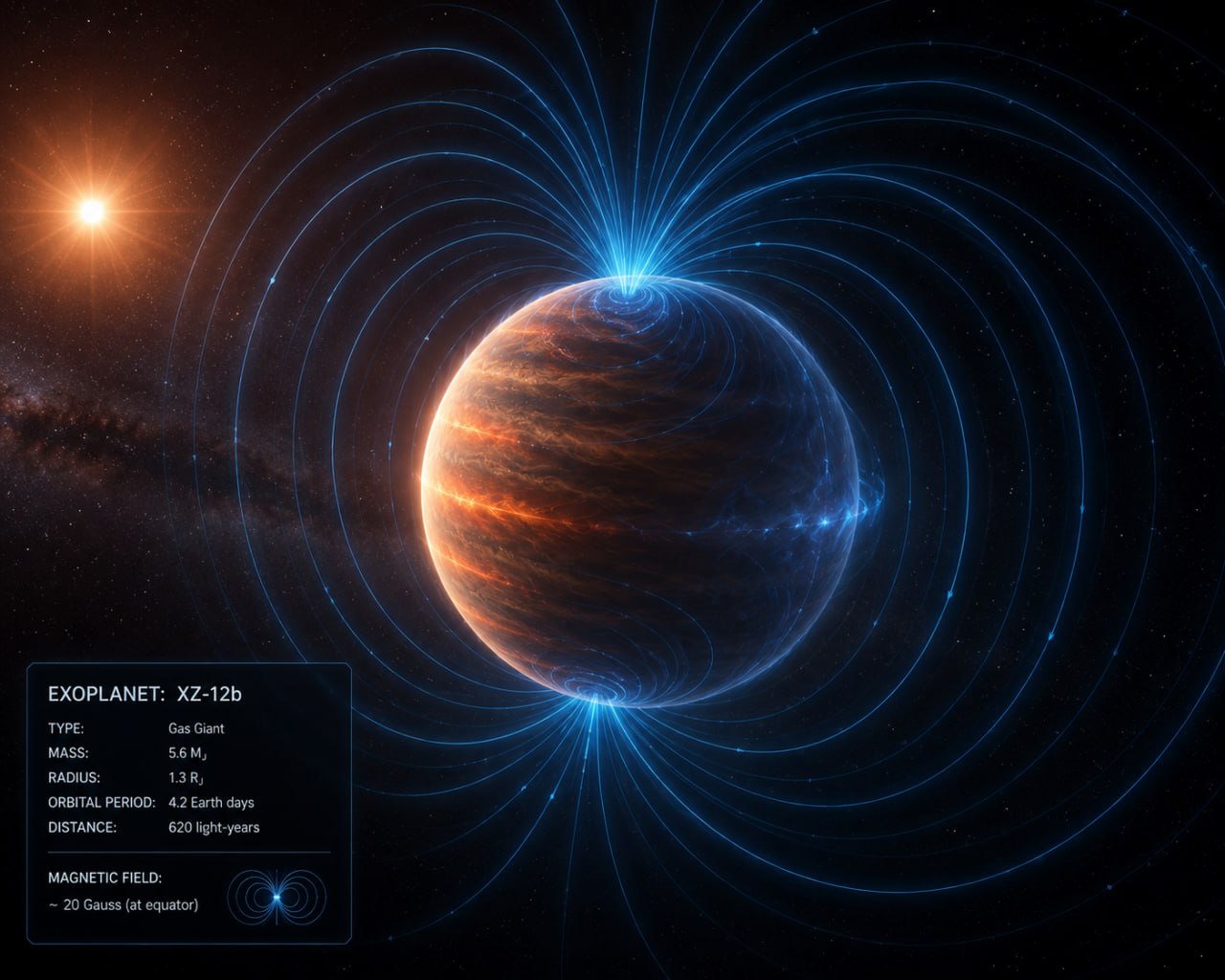
An international team has detected magnetic fields on exoplanets for the first time, using wind measurements from seven "hot Jupiter" worlds to reveal how these planets retain their atmospheres against extreme stellar bombardment. The discovery, published in early June 2026, provides astronomers with a new method to assess which distant worlds might sustain habitability.
Observations from ESO's Very Large Telescope in Chile and Gemini North in Hawaii tracked atmospheric winds on tidally locked exoplanets orbiting close to their host stars. These worlds present extreme conditions: scorching day sides facing perpetual stellar radiation while night sides freeze in darkness. Winds exceeding 15,000 miles per hour would naturally rush from the heated day side to the cold night side, yet measurements show these winds move far more slowly than atmospheric models predicted without magnetic influence.
The gap between predicted and observed wind speeds reveals the presence of magnetic fields strong enough to constrain atmospheric circulation. On Earth, magnetic fields serve as a shield against solar wind erosion that would otherwise strip away our atmosphere over geological timescales. Detecting comparable fields on exoplanets suggests these distant worlds possess one of the critical conditions for long-term atmospheric retention and habitability.
The research team analyzed seven hot Jupiters, a class of giant gas planets with orbital periods of just a few days. These worlds offer the clearest atmospheric signatures for study through spectroscopic techniques that measure wind velocities by analyzing molecular doppler shifts. The extreme conditions on hot Jupiters actually made them ideal test cases for this new detection method, though the technique should eventually apply to smaller, potentially habitable worlds farther from their stars.
The magnetic field strength inferred from wind behavior matches theoretical predictions about planetary dynamos generated in fluid-metallic layers beneath these atmospheres. The findings suggest that magnetic field generation, long understood on Earth and Jupiter, occurs across a broader range of exoplanet types than previously confirmed. This opens pathways to evaluate atmospheric stability on planets where direct magnetic measurements remain beyond current instrumental capability.
The discovery reframes how astronomers approach habitability assessment. Rather than requiring specialized magnetometers that cannot yet reach exoplanet distances, researchers can now infer magnetic protection by analyzing spectroscopic wind data already collected during atmospheric characterization studies. This transforms a measurement already planned for other science goals into a habitability indicator, multiplying the sample of worlds that can be evaluated for atmospheric retention potential.
The next phase involves applying this wind measurement technique to smaller exoplanets in wider orbits around their host stars, particularly those in potentially habitable zones where liquid water might exist on planetary surfaces. Understanding whether these temperate worlds possess the magnetic protection necessary to maintain atmospheres would substantially sharpen estimates of how many distant planets could plausibly harbor life. Further observations with upcoming space telescopes like the NASA James Webb Space Telescope and ground-based facilities will extend this magnetic field survey to new planet types.