SMILE Captures First X-Ray Portrait of Earth's Magnetic Shield
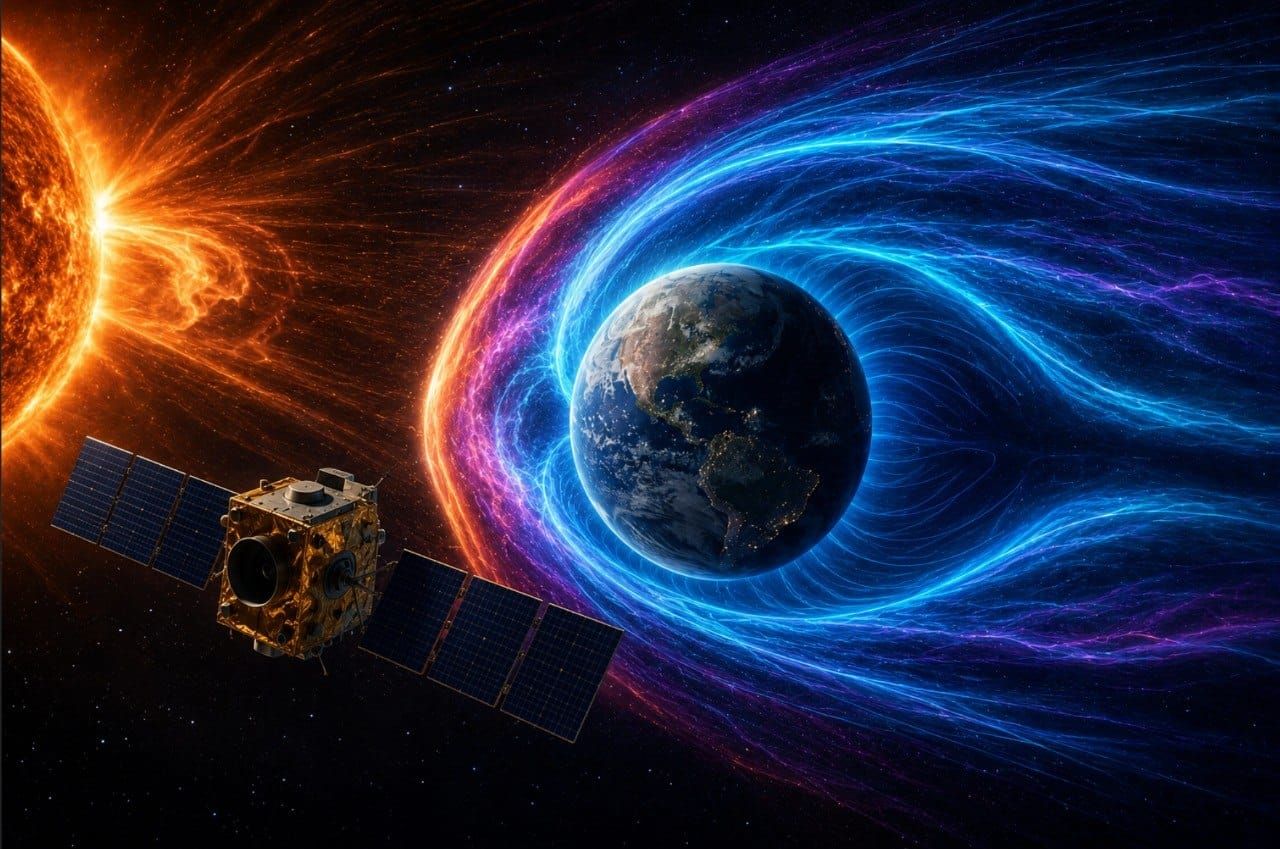
The European Space Agency and Chinese Academy of Sciences have opened an entirely new window onto Earth's magnetosphere with the successful launch of the SMILE mission, which lifted off aboard a Vega-C rocket from French Guiana early this morning. The spacecraft will deliver the first global X-ray images of the magnetosphere, the invisible magnetic cocoon that deflects the solar wind and protects the planet from dangerous radiation. The milestone represents both a scientific breakthrough and a rare sustained partnership between Europe and China in an era of fractured international space cooperation.
SMILE resolves a decades-long gap in Earth observation. Scientists have studied the magnetosphere extensively with in-situ instruments and radio remote sensing, but never with direct imaging. The X-ray approach targets a unique signature: oxygen and nitrogen ions flowing from Earth's atmosphere collide with solar wind particles, producing X-rays that reveal the magnetosphere's structure in real time. This capability has proven impossible to achieve until now, requiring the combined expertise and resources of ESA and the Chinese Academy of Sciences working in concert.
The joint program began development over a decade ago, well before current geopolitical tensions between the United States and China intensified. That sustained commitment carries weight. While NASA increasingly limits cooperation with Chinese entities, this mission demonstrates that European institutions have maintained a different approach to collaboration in space. The partnership survived design reviews, budget negotiations, and the institutional caution that often stalls international programs.
SMILE lifted off at 04:52 BST on May 19 after reaching the launch pad on a Vega-C rocket, a medium-lift vehicle operated by Arianespace. Telemetry confirmed the spacecraft achieved its intended polar orbit. The mission carries two primary instruments: a soft X-ray imager built by a European consortium and a magnetometer provided by Chinese researchers. These tools will work in concert to map how Earth's magnetic field responds to solar storms, capturing dynamic behavior that ground-based and orbital measurements have never fully resolved.
The data generated by SMILE carries direct practical consequence. Solar storms regularly threaten satellite constellations, power grids, and GPS networks that underpin modern telecommunications and navigation. Understanding how the magnetosphere responds to solar wind variations improves space weather forecasting, potentially preventing billions of dollars in infrastructure damage. Power utilities, satellite operators, and aviation authorities have a direct interest in SMILE's findings.
The mission also tests whether Europe and China can sustain deep collaboration in space when the United States pursues a more restrictive stance. If SMILE delivers the science as planned, it creates a template for future joint missions. If technical problems emerge, both parties face political pressure to step back from further cooperation. The stakes extend well beyond this single observatory.
The spacecraft will require several weeks to reach its final operational orbit and complete systems checkout. Initial data is expected within two months of that commissioning phase.