Green Bank Telescope Provides Independent Navigation Checkpoint for Lunar Missions
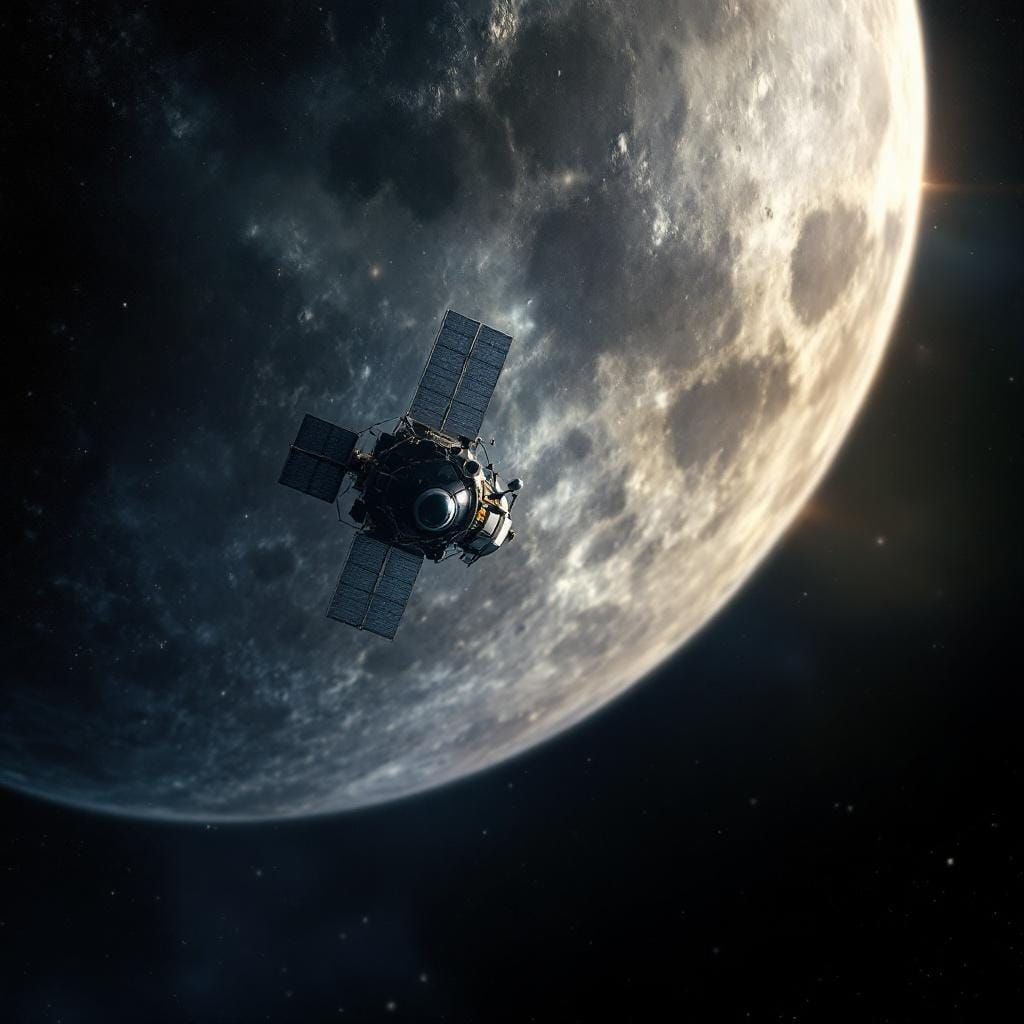
NASA's 100-meter Green Bank Telescope in West Virginia tracked the Artemis 2 Orion spacecraft continuously for five days during its lunar flyby, gathering precise position and velocity data on the four crewed astronauts as they orbited the Moon. The feat marks the first time a ground-based radio telescope has maintained such detailed tracking of a crewed spacecraft beyond Earth orbit since the Apollo program, establishing a critical capability for future lunar missions.
Ground-based deep space tracking has largely become a domain of NASA's Deep Space Network -- the agency's constellation of massive radio dishes distributed globally. But the Green Bank Telescope's independent confirmation of Orion's trajectory during Artemis 2 demonstrated that terrestrial radar astronomy can serve as a vital redundancy layer for crewed missions operating at lunar distances. Mission controllers monitoring the data stream noted the profound reality of what they were observing: four human beings represented in the telescope's positional measurements, traveling 240,000 miles from Earth.
The Green Bank Telescope, operated by the National Science Foundation, is among the world's most sensitive steerable radio dishes. Its ability to lock onto Orion's relatively weak radio transponder signal and maintain a continuous data link across the lunar distance required extraordinary coordination between NASA's mission control and the telescope's operations team in Pocahontas County, West Virginia. The tracking data provided independent verification of the spacecraft's navigation systems -- an essential redundancy for crewed deep space operations where navigation errors can compound into mission-ending consequences.
Orion's onboard guidance systems compute the spacecraft's position using star trackers, inertial measurement units, and periodic radio updates from NASA's Deep Space Network. The Green Bank measurements allowed mission planners to cross-check these calculations against an entirely separate measurement source. During Artemis 2, the independent verification confirmed that Orion's navigation was performing within expected parameters. For future missions to the lunar surface, particularly Artemis III's planned landing in 2026, this type of ground-based checkpoint becomes even more critical -- a second opinion that could identify and correct navigation drift before it affects descent or ascent burns.
The implications extend beyond Artemis. As NASA and international partners prepare for sustained lunar operations and eventual Mars missions, the capacity to track crewed spacecraft from multiple independent ground stations reduces single-point failure risks. A spacecraft's onboard navigation system could degrade or fail; Deep Space Network stations could experience technical issues. But a distributed network of capable radio observatories provides resilience. The Green Bank Telescope has now proven its place in that network.
NASA and the National Science Foundation have already begun planning for Green Bank's role during Artemis III's lunar landing and surface operations. Controllers expect the telescope to maintain continuous tracking capability throughout the mission, with particular emphasis on the critical descent and ascent phases when astronauts will be most vulnerable.