NASA Exercises SpaceX Option for Six Additional Crew Missions as Boeing Starliner Remains Uncertified
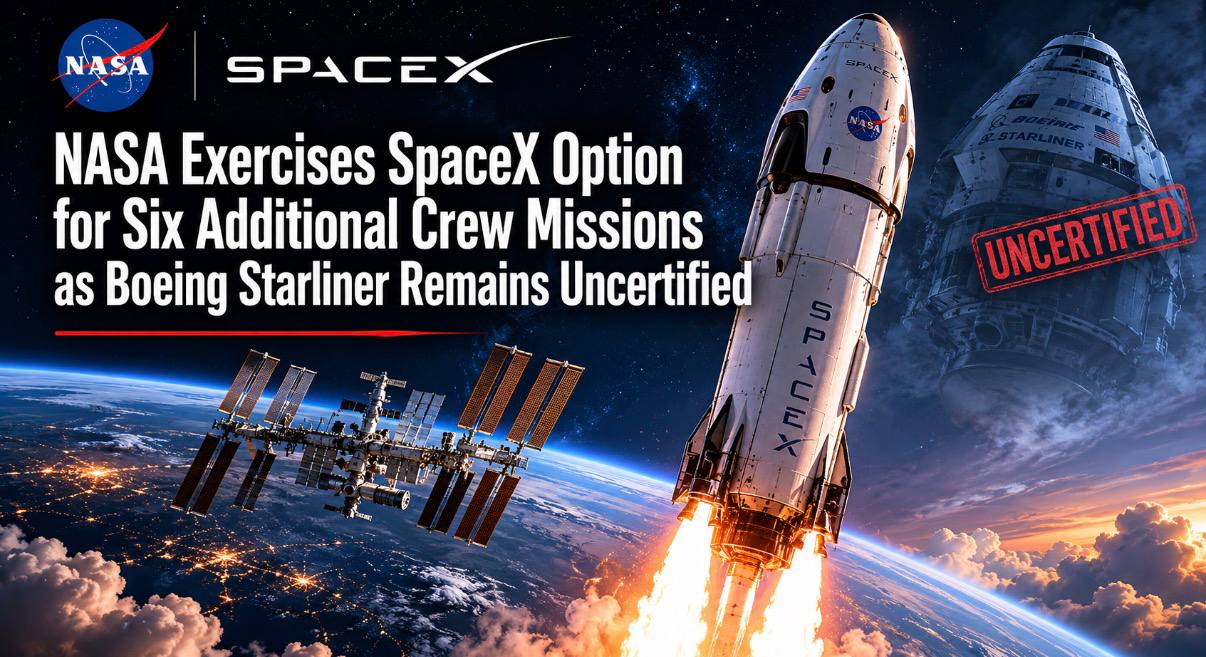
NASA will purchase six additional crew rotation missions from SpaceX under an expanded Commercial Crew contract, with three ordered immediately and three reserved for future use through the end of International Space Station operations. The procurement follows Boeing's continued inability to obtain NASA certification for Starliner to conduct routine crew exchanges to the orbiting laboratory.
The space agency selected both SpaceX and Boeing in 2014 to develop independent pathways for American astronauts to reach the ISS, ending reliance on Russian Soyuz vehicles. SpaceX's Crew Dragon completed its first crewed flight in 2020 and has since flown multiple successful missions. Boeing's Starliner completed an uncrewed test flight in 2019 but has remained grounded while the company addressed technical issues and safety concerns identified during orbital checkout phases. An uncrewed abort test in 2022 and a subsequent crewed test flight in 2024 were intended to clear the final certification hurdles, yet NASA has not approved Starliner for operational crew rotations.
The additional six missions represent a substantial increase to SpaceX's existing contract scope. NASA indicated the three immediately ordered missions will launch through 2030, with pricing determined through a competitive process. The three optional missions provide scheduling flexibility if ISS operations extend beyond current deorbiting plans or if unforeseen factors disrupt the crew rotation cadence. A SpaceX spokesperson acknowledged the award but declined to specify contract value, stating the company remains committed to reliable crew access for NASA missions.
Boeing's Starliner program has encountered repeated technical challenges since its development began more than a decade ago. The spacecraft experienced thruster malfunctions during the 2024 crewed test mission and helium system anomalies that necessitated additional engineering reviews. NASA halted Starliner flights pending resolution of those issues, effectively removing Boeing from the crew rotation schedule indefinitely. The decision to expand SpaceX's manifest rather than wait for Starliner certification represents a significant acknowledgment that Boeing's vehicle may not achieve operational status in a timeframe relevant to ISS utilization.
The shift consolidates American crew access under a single provider, fundamentally altering NASA's original redundancy strategy. SpaceX now holds near-monopoly control over domestic astronaut transportation, eliminating the competitive oversight and risk distribution the agency sought through the Commercial Crew Program. While Crew Dragon's reliability record has proven strong, dependence on a single vehicle architecture creates vulnerability to production delays, technical anomalies, or launch facility disruptions. Boeing's inability to deliver on a commitment made a decade ago raises questions about program management, technical execution, and the broader competitiveness of the U.S. space industrial base.
NASA will continue attempting to certify Starliner for crew missions, but the service procurement signals the agency has effectively moved forward without it. The next milestone occurs if Boeing successfully completes additional uncrewed test flights and certification activities, restoring Starliner as a secondary provider.