NASA Revises Artemis III Into Orbital Lander Test, Pushes Moon Landing to 2028
NASA will launch four astronauts into low-Earth orbit in summer 2027 to conduct crewed docking tests with lunar landers built by SpaceX and Blue Origin, reshaping Artemis III into a test flight rather than a landing mission. The agency now targets Artemis IV in 2028 for the first crewed lunar landing since Apollo 17 in December 1972.
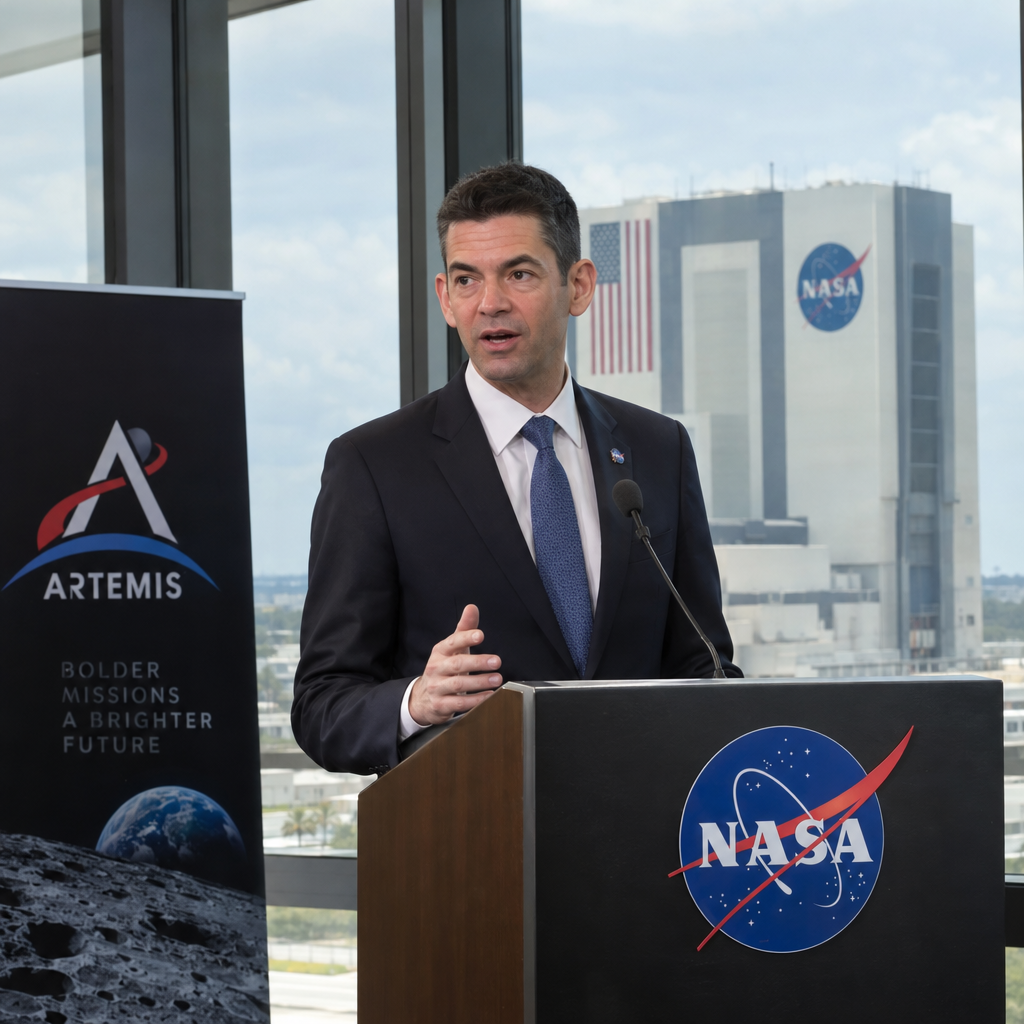
The updated roadmap was presented October 23 at a Kennedy Space Center press conference, where NASA Administrator Jared Isaacman and agency officials detailed the next steps toward returning American astronauts to the Moon. Under the revised plan, Artemis III will serve as a critical test mission for the spacecraft and procedures needed for a lunar surface landing, evaluating two commercially developed landers with astronauts aboard before any descent to the Moon is attempted.
The mission brings together three heavy-lift launch vehicles operated by NASA and two commercial companies: NASA's Space Launch System, SpaceX's Starship and Blue Origin's New Glenn. The 14-day flight will test how Orion, NASA's crewed deep-space spacecraft, interfaces with each independently developed lander.
The sequence begins with Blue Origin launching a test version of its Blue Moon Mark 2 lunar lander aboard New Glenn from Launch Complex 36 at Cape Canaveral Space Force Station. NASA will then launch four astronauts aboard Orion on the Space Launch System from Launch Complex 39B at Kennedy Space Center. Orion is not designed to land on the Moon.
Once in low-Earth orbit, Orion will rendezvous and dock with Blue Moon. The astronauts will enter the lander to evaluate its crew cabin, life-support systems, controls and other equipment needed for future lunar surface operations. After those tests, Orion will separate and prepare for a second docking demonstration. SpaceX will launch a test version of its Starship lunar lander from Launch Complex 39A at Kennedy Space Center, and Orion will dock with Starship for approximately two hours to evaluate the spacecraft interface and crew transfer procedures. Following the demonstrations, Orion will return the astronauts to Earth, reentering the atmosphere before descending under parachutes for an ocean splashdown.
Each launch system carries a distinct role. The Space Launch System carries the astronauts aboard Orion and provides the capability to send the crew beyond Earth orbit on future missions. New Glenn transports Blue Origin's Blue Moon Mark 2 test lander, central to the company's broader plans to deliver spacecraft, satellites and large payloads beyond Earth. Starship serves as both a launch vehicle and the basis for SpaceX's lunar landing system, part of a fully reusable architecture being developed to transport large payloads and crews to Earth orbit, the Moon and eventually Mars.
NASA says the mission will provide an opportunity to test how Orion interacts with two independently developed lunar landers before committing astronauts to a surface landing. The demonstrations will allow the agency to evaluate docking hardware, crew access, life-support systems and operational procedures under actual spaceflight conditions.
The next milestones named by NASA are the summer 2027 Artemis III test flight and the Artemis IV mission in 2028, which the agency is targeting for the first crewed lunar landing since Apollo 17.