Saudi Arabia Joins Global Alien Signal Hunt With First LaserSETI Site in Asia
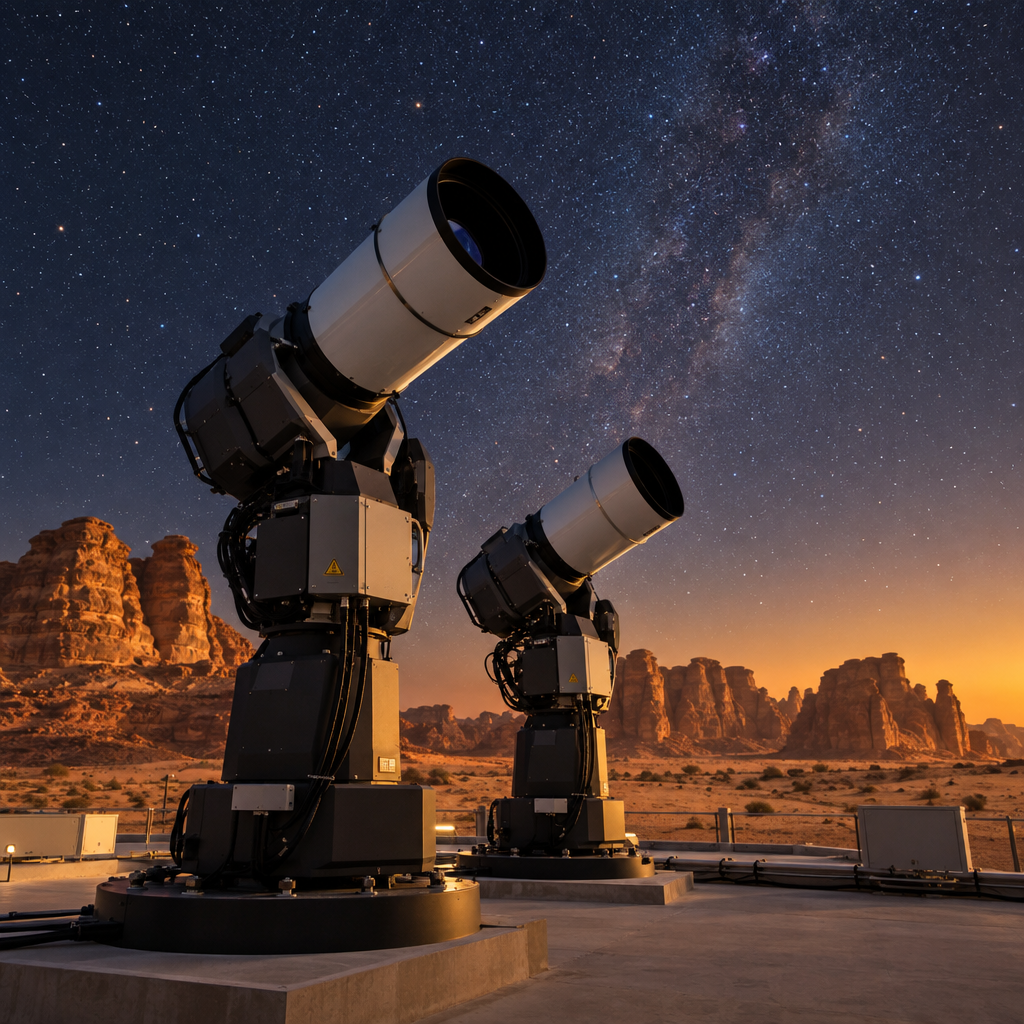
Saudi Arabia has installed and commissioned a pair of LaserSETI optical detectors at AlUla Manara, making the kingdom the fifth location in a growing network scanning the sky for laser signals from technological civilizations. The detectors became fully operational after their installation on August 19, 2026, and mark the first LaserSETI site in Asia.
The LaserSETI network, under development since 2024 by the SETI Institute, searches for optical laser signals that could originate from extraterrestrial intelligence. AlUla is the fifth site to join, following locations in California, Hawaii, Puerto Rico, and Arizona. The SETI Institute, a non-profit body, conducts its searches using the Allen Telescope Array and other ground-based facilities, and has also used space telescopes including Hubble.
LaserSETI watches the entire sky continuously, allowing it to catch rare transient events, whereas most other SETI efforts are slower or focus on specific targets. Most of what the detectors capture will be flashes of light from cosmic events, but the goal is to eventually detect a laser originating from another civilization. The chances of doing so increase with sky coverage, which is why the network is expanding.
The detectors use cameras with commercially available lenses that image about 75 degrees of the sky, along with off-the-shelf solid-state detectors. A grating behind each lens differentiates between starlight, which produces a complete spectrum from blue to red, and lasers, which show up only at a characteristic wavelength. Parts of the detectors are 3-D printed, and only the transmission grating and stainless-steel enclosure are custom made. Each unit also carries a powerful computer that analyzes incoming data in real time, eliminating expensive data storage and enabling real-time alerts.
The instruments sit at AlUla Manara, a remote plateau about 74 kilometers north of AlUla and roughly 380 kilometers from Medina. AlUla is being developed as Saudi Arabia's first major astronomical observatory, is the kingdom's first UNESCO World Heritage Site, and is a Dark Sky Park. Plans call for the site to eventually host a 4-meter telescope and a pair of 2-meter telescopes.
"Two years ago, we announced our intention to bring LaserSETI to AlUla. Today, the instruments are installed, commissioned and observing the sky," said Dr. Franck Marchis, Senior Planetary Astronomer and Director of Citizen Science at the SETI Institute. "AlUla gives LaserSETI an important new geographic vantage point and connects this remarkable astronomical site to a growing global network." Eliot Gillum, Director of LaserSETI, who designed and builds the units, said the project "was designed from the beginning as a global observatory rather than a single telescope," and that each new location improves the ability to monitor the sky continuously and compare observations of unusual events from different parts of the world.
Naif Al Malik, AlUla Manara Executive Program Head, said the commissioning "marks an important milestone in our collaboration with SETI Institute, translating our shared ambition into scientific capability on the ground." He added that connecting AlUla's dark skies to a global network creates new opportunities for scientific research, international collaboration, and knowledge exchange, while strengthening AlUla's growing role in astronomy and scientific discovery.
The live status of each LaserSETI observatory can be viewed online. Plans for AlUla Manara include the future addition of larger telescopes, contingent on their successful development.