NASA Safety Panel to Urge Review of Artemis IV Lunar Landing Plans
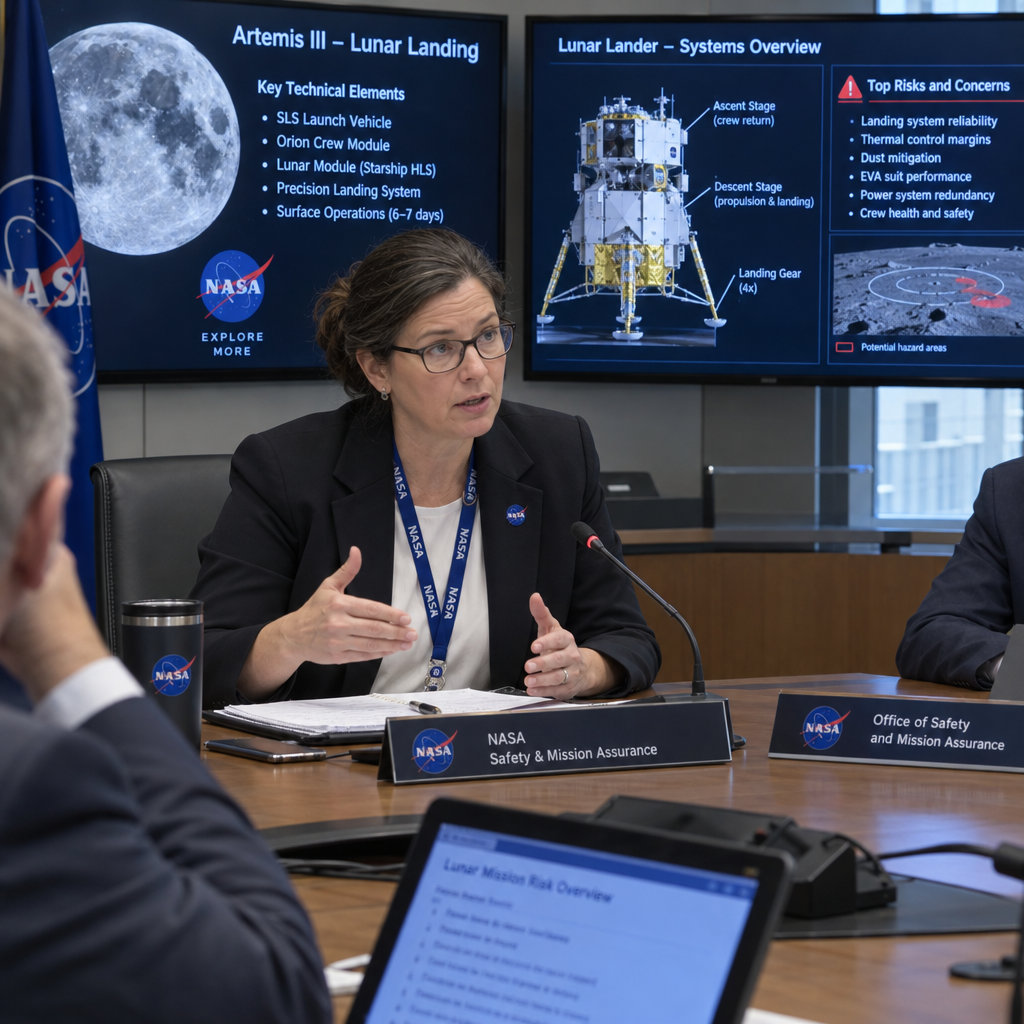
NASA's Aerospace Safety Advisory Panel will soon open a formal recommendation that the agency re-examine its plans for the Artemis IV mission, currently slated as the first American crewed landing on the Moon since 1972. The panel raised concerns about the Human Landing Systems being built by SpaceX and Blue Origin and about the mission's risk posture. A formal recommendation to reconsider a flagship lunar mission is unusual and adds to questions about the Artemis architecture.
Reporting on its fourth quarter 2026 meeting, the panel praised NASA Administrator Jared Isaacman for positive changes at the agency. It commended his decision, taken shortly after he took office, to change Artemis III from a lunar landing to an Earth orbital flight to practice rendezvous and docking with test articles of the two Human Landing Systems, SpaceX's Starship and Blue Origin's Blue Moon MK2. Artemis II flew around the Moon in April.
ASAP's concern centers on Artemis IV, now envisioned as the first Artemis lunar landing, headed to the Moon's South Pole, an environment with steep slopes, low Sun angles, and temperature extremes, unlike the equatorial Apollo sites. The mission involves many firsts. The Human Landing Systems are entirely new designs requiring in-space refueling, which depends on an orbiting cryogenic fuel depot to compensate for propellant boil-off. Such depots do not yet exist, and in-space cryogenic propellant transfer has not been demonstrated. Kelvin Manning, NASA Deputy Associate Administrator for Human Exploration, said SpaceX plans to demonstrate in-space cryogenic transfer in early 2027.
ASAP member Charlie Precourt, a former NASA astronaut, said the panel had been told 22 launches would be needed to provide the propellant for the lander to reach lunar orbit. SpaceX CEO Elon Musk said on X that figure was incorrect and the number would be six to eight. Precourt noted NASA requires only one uncrewed test to demonstrate the lander can land, followed by an engine restart, but does not require a demonstration of liftoff and return to lunar orbit. Manning said the uncrewed SpaceX landing test is planned for late 2027. Precourt added that Artemis IV will mark the first use of cryogenic propellants on the lunar surface, where abort options are more limited than Apollo, which used hypergolics.
Timeline is a further challenge. Isaacman is determined to land astronauts on the Moon before President Trump leaves office in January 2029 and before China lands taikonauts. The current plan calls for the Earth orbiting Artemis III in 2027 and Artemis IV in 2028, with Isaacman hoping for a second landing in 2028 as well.
Precourt said the panel will recommend that NASA re-examine the mission objectives and potentially the system architecture for Artemis IV and subsequent missions to establish a more balanced approach to risk, prioritize objectives-driven planning, and maintain a consistent cadence of flight missions. For every test objective, including uncrewed lander demonstrations from the service providers, NASA should develop a detailed plan for testing and data collection, incorporating both ground and flight tests to identify and mitigate risks. The panel said this structured approach would support a successful crewed landing and the creation of a sustainable lunar base.
NASA will give an Artemis update tomorrow. The forthcoming ASAP recommendation to Isaacman on how to proceed with Artemis remains to be opened.