Nereid Emerges as Sole Survivor of Neptune's Catastrophic Cosmic Collision
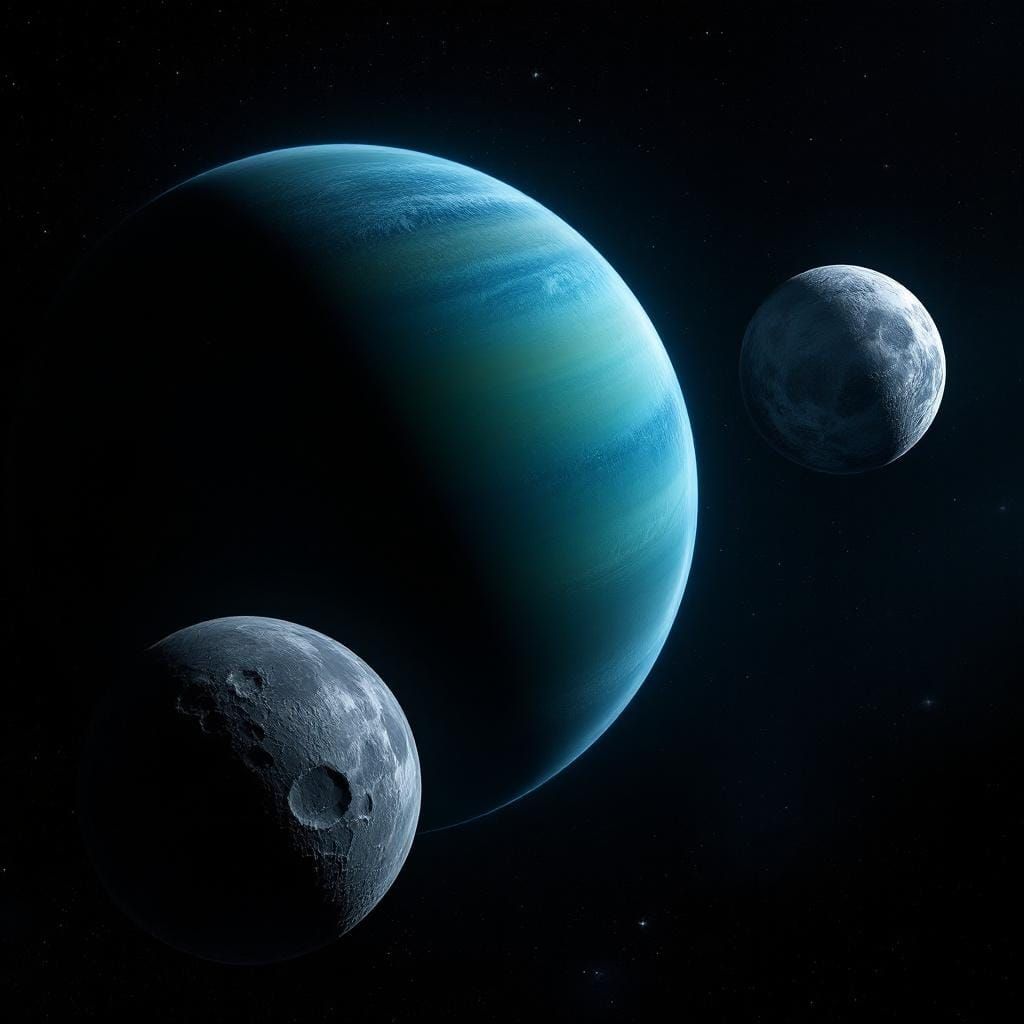
A Caltech-led analysis of data from NASA's James Webb Space Telescope has revealed that Neptune's enigmatic moon Nereid may be the last remaining witness to a violent planetary upheaval billions of years ago. The research, published May 20, 2026, suggests Nereid originated near Neptune itself rather than being captured from the outer solar system, making it the only known survivor of Neptune's original moon system that was likely obliterated when the planet's massive satellite Triton arrived.
Neptune's moon system bears the scars of catastrophic violence. Triton, Neptune's largest moon, orbits retrograde, which means it travels opposite to the planet's rotation. This unusual trajectory has long led scientists to conclude that Triton originated in the Kuiper Belt and was gravitationally captured by Neptune billions of years ago. That capture event would have generated immense gravitational chaos, destabilizing any existing moons and flinging them into space or destroying them entirely through collision. Nereid's eccentric orbit and small size have made it a puzzle for decades, but the new findings suggest a solution to that puzzle.
The Caltech team analyzed Nereid's composition and orbital characteristics using JWST data collected in 2024, comparing the moon's properties to models of both in-situ formation near Neptune and capture from the outer solar system. The evidence tilted decisively toward in-situ origin. Nereid appears to have formed in Neptune's gravitational neighborhood rather than arriving as an interloper from beyond. This distinction carries major implications. If Nereid formed near Neptune, it was present during Triton's arrival. Its survival suggests either extraordinary orbital luck or a position sufficiently distant from Triton's path to escape destruction.
Nereid's discovery transforms Neptune from a footnote in planetary science into a case study in solar system violence. The moon sits roughly 5.5 million kilometers from Neptune, traveling on one of the most eccentric orbits of any moon in the solar system. That unusual trajectory may itself be a relic of Triton's arrival, a gravitational scar left by the encounter. The implications extend beyond Neptune. Understanding how moons survive or perish during planetary collisions informs models of moon formation around exoplanets and provides insight into the violent early history of the solar system itself.
The findings also challenge assumptions about captured moons. Triton's arrival was not merely a singular event but a cataclysmic restructuring event that erased an entire moon system. Nereid's survival, whether through distance or chance, means it carries ancient information about Neptune's original configuration and the early solar system's architecture.
Researchers will continue analyzing JWST observations of Nereid to search for additional clues about Neptune's original moon system and the scale of disruption Triton's arrival caused. New observations may reveal whether other micro-moons escaped destruction or whether Nereid truly stands alone.