OST Insights: The 15 km/s Problem for Space Data Centers
Every major player in space-based datacenters has agreed on the same orbit. But they haven't agreed on which direction to fly through it.
There is a gold rush happening 650 kilometers above our heads.
SpaceX has filed with the FCC for up to one million orbital datacenter satellites. Google's Project Suncatcher plans to launch TPU-equipped test satellites with Planet Labs by early 2027. Jeff Bezos’ Blue Origin's Project Sunrise proposes 51,600 of its own. Starcloud - the YC-backed startup that trained the first AI model in space last November - just raised $170 million and filed for 88,000 satellites. Cowboy Space, another startup building both the rocket and the datacenter, recently announced a $275 million raise.
The logic is simple. AI needs enormous amounts of electricity. On Earth, that means power grids, land, cooling systems, permits, and political fights over all of the above. In space, there is sunlight almost all the time, no clouds, no zoning hearings, and no local grid to overload.
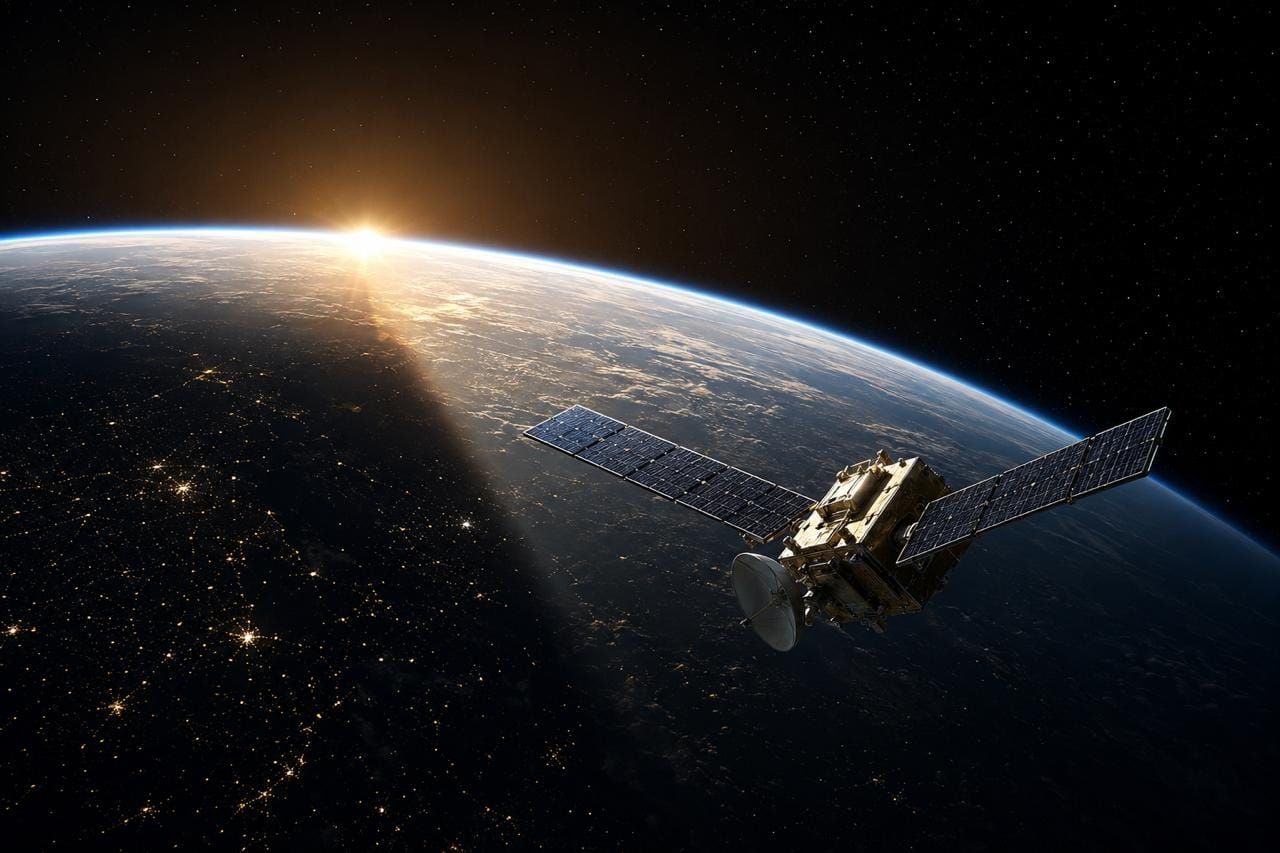
Picture the sunrise line moving across Earth right now - a permanent twilight band circling the planet. A satellite flying above that line can stay in sunlight almost all the time. No night or darkness - just 24/7 solar power for 365 days/year. That is why this orbit is so attractive for space-based data centers. Google estimates solar panels there could produce up to 8x more power than the same panels on a rooftop in Arizona.
This orbit has a name: dawn-dusk sun-synchronous. It has become the consensus answer to one of AI's biggest headaches - where do you find enough electricity to run the next generation of models without melting the power grid? Everyone agrees on the destination. What nobody has agreed on is which direction to fly once they get there. And that disagreement, left unresolved, has the potential to end the orbital datacenter industry before it begins.
One Orbit, Two Directions
Sun-synchronous orbit (SSO) isn’t one specific path - it’s a type of orbit that keeps the satellite at the same angle to the Sun throughout the year. One version, called a dawn-dusk orbit, follows the line between day and night on Earth. Because of that, the satellite stays in sunlight almost all the time. That makes it very attractive for orbital data centers, since more sunlight means more consistent solar power.
But there’s an important detail: dawn-dusk SSO can run in two opposite directions. One version crosses the equator heading north on the daylight side. The other crosses heading north on the night side. From a solar power perspective, both are essentially the same. They both keep the satellite in near-constant sunlight.
The real difference is safety. If two satellites are moving in the same direction at the same altitude, they may only approach each other at a few meters per second. That’s still serious, but it’s relatively manageable. If they are moving in opposite directions through the same orbital band, the closing speed becomes enormous. At the relevant altitudes, that can be around 15 kilometers per second — roughly 20 times faster than a rifle bullet. At that speed, a collision doesn’t just break hardware - it vaporizes it.
What 15 km per second Actually Looks Like
We already know what happens when satellites collide at these velocities. In 2009, Iridium 33 and Cosmos 2251 met at a closing velocity of 11.7 km/s. The collision released energy equivalent to multiple tons of TNT and produced over 1,800 pieces of trackable debris. Some of those fragments will remain in orbit until the end of the century. The two satellites had a combined mass of ~1,500 kilograms. Now imagine that scenario scaled up. Future orbital datacenters will likely involve single platforms massing 20,000 kilograms or more, carrying kilometer-scale solar arrays packed with GPUs worth more than their weight in gold. A head-on collision between two orbital datacenters would dwarf the Iridium-Cosmos event as the debris field would sit directly in the orbital band that the space-based datacenter industry is investing hundreds of billions of dollars to develop. In theory, it could make one of the most valuable regions of space unusable for generations.
The Coordination Problem Nobody Owns
On Earth, highways only work because everyone agrees which side of the road to drive on - this is relatively simple and mandated by governments and law enforcement. In space, there is currently no binding international framework that dictates which direction satellites should travel in sun-synchronous orbit. The geostationary belt, by contrast, solved this problem decades ago. GEO satellites need to keep pace with Earth's rotation, so every operator naturally flies eastward. The International Telecommunication Union added a slot system on top. Head-on collisions are geometrically impossible. The system isn't perfect, but it works precisely because everyone agreed on a common set of rules early. SSO has no equivalent. The direction of travel is a design choice made by individual operators. Right now, most SSO satellites happen to fly in compatible directions. But "most" is not "all," and there is no mechanism to enforce alignment as the population scales from thousands to potentially millions. This is a classic coordination game. The payoff for choosing either direction is roughly identical - until someone else chooses differently. Then it becomes a prisoner's dilemma with thermonuclear consequences.
● SpaceX's filing specifies altitudes between 500 and 2,000 km and inclinations from 30 degrees to sun-synchronous - an enormous and intentionally vague range. The company has requested a waiver of FCC milestone requirements and provided few specific orbital parameters.
● Google's Project Suncatcher research describes clusters of 81 satellites in dawn-dusk SSO at around 650 km, but hasn't publicly committed to a specific ascending node convention.
● Blue Origin's Project Sunrise targets SSO between 500 and 1,800 km. No directional commitment is public.
● Starcloud, which has actual hardware in orbit and the most aggressive near-term timeline, appears to be the one player actively trying to coordinate - advocating for uniform dawn-dusk adoption across all SSO datacenter operators.
The temptation is to assume smart engineers will sort this out. Collision avoidance is already standard practice - SpaceX's Starlink constellation performs thousands of maneuvers per year. But there is a fundamental difference between dodging a piece of debris you can see coming and sharing an orbital highway with oncoming traffic at 15 km/s.
The Window Is Still Open
The orbital datacenter industry is in its infancy. Starcloud has one satellite with one GPU. Axiom Space launched two datacenter nodes in January 2026. Google's test satellites are two years away. SpaceX's million-satellite vision depends on Starship achieving commercial cadence, which even optimistic estimates place in 2028 or 2029. In other words, the lanes are not locked in yet. The solution is simple: pick a direction, publish it, and get the major operators to align before large constellations are deployed. It does not really matter whether that happens through a voluntary industry standard, an FCC licensing condition, an ITU recommendation, or a direct agreement between the companies. What matters is that it happens before the first counter-rotating constellations are deployed - because after that, every satellite flying the wrong way becomes a legacy obligation with decade-long consequences. Space-based AI infrastructure may become one of the most important industries of the next decade, and failing to solve this dilemma could put the entire industry at risk.
The industry leaders need to answer a very simple question: which direction is everyone flying?