South Korea Approves Sovereign LEO Constellation, Pulls Lunar Landing Forward to 2030
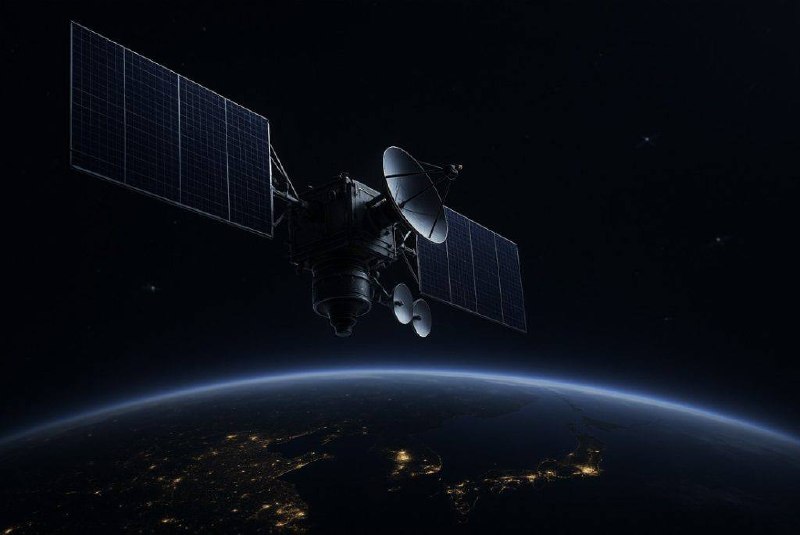
The South Korean government formally authorized an industrial space strategy on Friday, July 3, 2026, to build a sovereign low Earth orbit satellite communications network by 2035. The plan, frequently designated the "Korean version of Starlink," commits the country to a self-reliant aerospace capability administered through the newly operational Korea AeroSpace Administration.
The initiative was deliberated and approved during the 5th National Space Committee meeting chaired by President Lee Jae-myung in Jinju, South Gyeongsang Province. South Korea aims to raise its share of the global space economy from roughly 0.7 percent to 3.0 percent by 2035, a target revenue base of 70 trillion won, approximately 49 billion dollars. In a parallel move to solidify domestic launch demand, the committee pulled forward the national uncrewed lunar landing target by two years, from 2032 to 2030.
The K-LEO project is framed as the "hyper-space" infrastructure layer needed to support the 6G era under 3GPP Release 21 Non-Terrestrial Network parameters. While South Korea maintains near-ubiquitous urban fiber and over 99 percent baseline 4G and 5G coverage, its infrastructure remains blind across deep maritime shipping corridors, remote air traffic control vectors, and high-latitude zones. The technical architecture is guided by the Electronics and Telecommunications Research Institute, which recently concluded an initial 200 Gbps spatial-space wireless link proof-of-concept. The system uses an Intelligent LEO Satellite Conditional Handover scheme backed by multi-agent reinforcement learning to maintain link stability for fast-moving Urban Air Mobility aircraft, military drones, and maritime vessels.
Execution will be anchored by a 55 trillion won, 38.5 billion dollar private-public investment pledge formalized through Hanwha Group Vice Chairman Kim Dong-kwan. Following its recent purchase of a dominant secondary equity stake in Korea Aerospace Industries, Hanwha manages the entire supply chain needed to manufacture and launch the constellation. Implementation proceeds in three phases: finalizing mass-production cleanrooms along the Southern Advanced Industrial Belt of Changwon, Sacheon, and Jinju and delivering initial automated satellite buses by 2030, launching testbeds for in-orbit verification of regenerative repeaters and inter-satellite laser links by 2032, and completing primary constellation deployment by 2035.
KASA is evaluating scaling options ranging from 128 to 512 satellites, representing budgets from 4 trillion to 13.2 trillion won. Hanwha Systems' baseline defense architecture mandates an initial core constellation of 192 ultra-low-orbit Synthetic Aperture Radar and communications satellites, supplemented by 60 polar-phased assets to secure military communication sovereignty over the Arctic and the Korean Peninsula. All satellites will launch on homegrown vehicles built by Hanwha Aerospace under the principle "our satellites on our launch vehicles," relying on recurring flights of the liquid-fueled Nuri rocket, private small-to-medium solid-propellant launchers, and a mid-2030s fully reusable heavy-lift vehicle targeting 10 launches per year from Goheung Space Center.
The initiative establishes a public-private roadmap intended to transition South Korea into a self-reliant aerospace power. The authorization confirms an independent, military-driven LEO network within a domestic market where the Ministry of Science and ICT has already cleared both Starlink and Eutelsat OneWeb for commercial operations, with Hanwha Systems serving as OneWeb's exclusive domestic distributor through 2030.
Work now moves to the pan-ministerial task force managing the phased timeline, beginning with cleanroom finalization and delivery of the initial automated satellite buses by 2030, alongside the accelerated uncrewed lunar landing now targeted for the same year.