SpaceX's Starlink Now Provides Internet to Air Force One, Marking Shift in Military Satellite Strategy
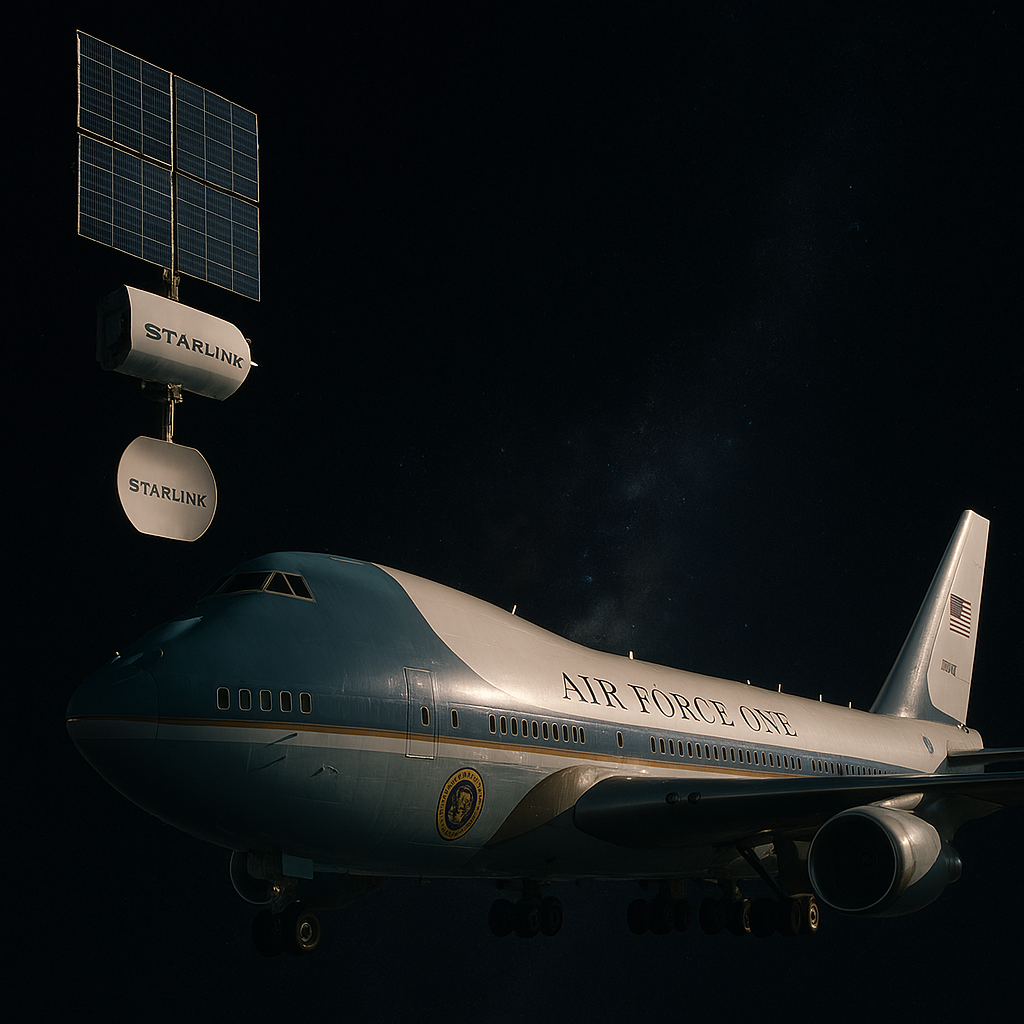
SpaceX confirmed on May 13 that its Starlink satellite internet system is operational aboard Air Force One, providing high-speed connectivity to the presidential aircraft during transpacific flights. The confirmation came from Elon Musk in response to imagery showing him aboard the plane alongside President Trump and Nvidia CEO Jensen Huang en route to Beijing. The deployment represents the most significant government validation of commercial satellite broadband to date.
The decision to equip Air Force One with Starlink reflects a broader Pentagon pivot toward leveraging commercial space infrastructure for critical military functions. For decades, the presidential aircraft relied on government-owned and operated communications systems. Starlink's integration signals that U.S. defense leadership now views commercial satellite networks as sufficiently secure and reliable for the nation's highest-priority communications needs. The shift accelerates a trend already underway across the Defense Department, where budget constraints and technical gaps have pushed military planners to depend more heavily on commercial providers.
Air Force One requires uninterrupted communications across all regions of the globe, with particular challenges over ocean crossings where traditional ground-based networks cannot reach. Starlink's constellation of low-earth orbit satellites addresses this gap by providing coverage even in remote areas where legacy systems lack redundancy. The system had to meet stringent security protocols before gaining approval for presidential use, meaning SpaceX invested in encryption and compartmentalization standards demanded by the White House Military Office and National Security Council staff.
The operational deployment follows months of testing and certification. Starlink achieved this milestone faster than many Pentagon acquisition programs, which typically require years of evaluation. The speed partly reflects the system's proven performance across other government users -- the U.S. Army, Navy, and State Department have all conducted Starlink trials in recent years. This cumulative operational data reduced Air Force One's certification timeline.
The imagery of Musk aboard the presidential aircraft underscores the personal relationship between SpaceX's founder and the current administration, a connection that has accelerated favorable regulatory treatment and government contracts. However, the technical case for Starlink's integration also stands independently: the system delivers gigabit-class speeds, operates globally without ground station dependencies, and offers redundancy across multiple satellite paths.
Starlink's elevation to presidential-level communications infrastructure has implications beyond connectivity. It positions SpaceX as a strategic asset to the U.S. government and creates policy leverage for future contracts. The Defense Department is expected to accelerate plans to integrate Starlink into military communications networks at all service branches. Competitors including Amazon's Project Kuiper and traditional defense contractors will face heightened pressure to match Starlink's performance and security posture.
Watch for the Pentagon to formally announce Starlink integration into doctrine for forward-deployed forces, military transport aircraft, and naval vessels. A public statement on Air Force One's capabilities and security measures could come during defense briefings or Congressional testimony in June.