Pentagon Wargame Simulates Nuclear Detonation in Orbit, Revealing Year-Long Casualty Zone
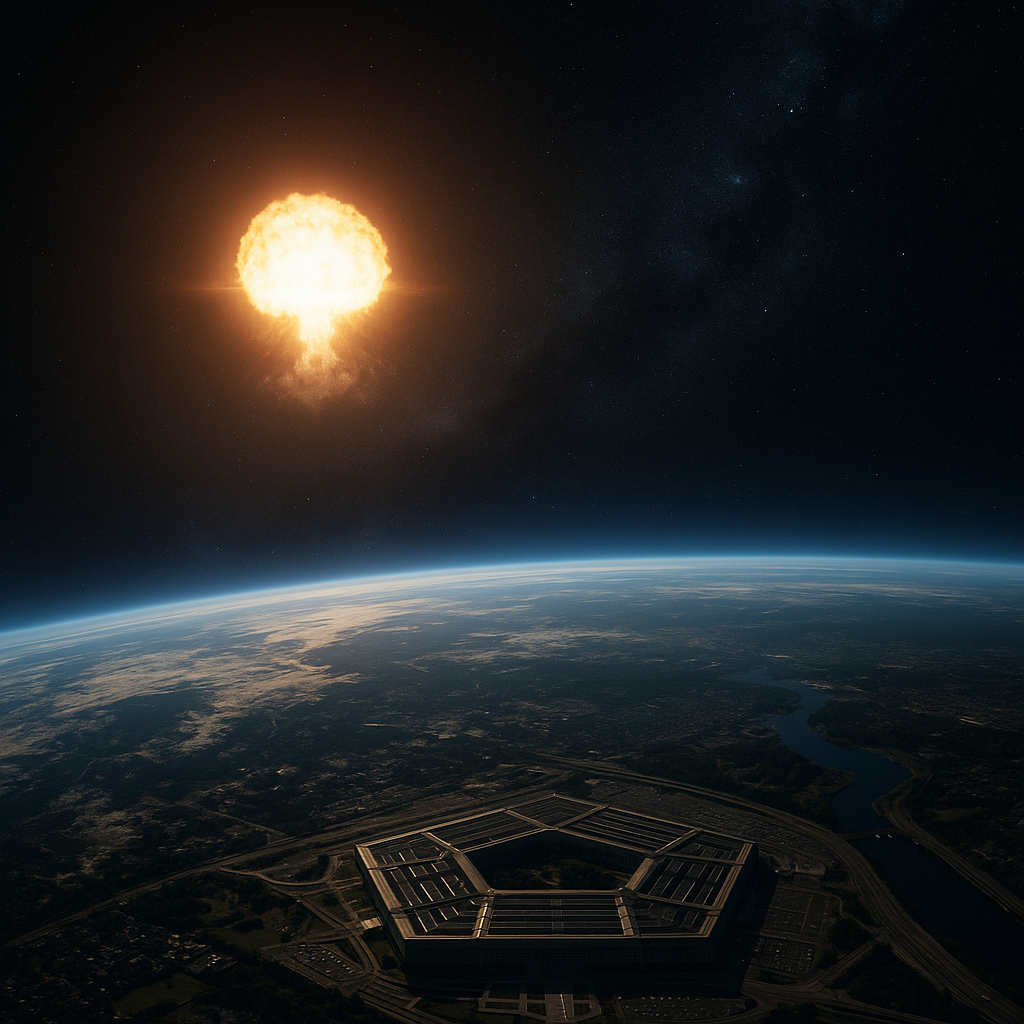
The U.S. military has begun a new wargaming series centered on a worst-case scenario: a nuclear weapon detonating in low-Earth orbit. The exercise simulates the cascading effects of such an event, which Pentagon officials say would render portions of LEO unusable for up to a year through radiation and electromagnetic damage alone.
The wargame represents an escalation in how seriously the Defense Department treats space as a contested domain. For decades, space operations proceeded on the assumption that the orbital environment remained largely protected by international norms and the sheer cost of destructive action. That calculus has shifted. Rising anti-satellite capabilities from peer competitors, combined with new doctrinal frameworks for space warfare, have pushed military planners to confront scenarios they once considered theoretical.
A high-altitude nuclear detonation would create a hostile radiation environment across a vast swath of orbital altitude. The electromagnetic pulse would disable or destroy unshielded electronics on satellites throughout the affected zone. More insidiously, charged particles trapped in the Earth's magnetic field would persist for months, bathing everything in that band of altitude with continuous radiation. This isn't a localized debris problem like a conventional anti-satellite test -- it's an environmental condition that would make operations hazardous for any spacecraft in the region, regardless of origin or purpose.
The wargame scenario underscores a fundamental vulnerability in modern space infrastructure. Civilian GPS networks, weather satellites, communications platforms, and military early-warning systems all occupy low-Earth orbit. A nuclear event affecting even a portion of that altitude band would have immediate ripple effects across critical infrastructure on the ground. Financial markets depend on GPS timing signals. Military command and control relies on space-based communications. Emergency responders use satellite networks for coordination.
Pentagon officials have begun articulating this challenge more openly in recent years. The 2023 National Defense Strategy identified space as a warfighting domain. The Space Force has been restructured around the premise that defending orbital assets is now a primary mission. Wargames like this one formalize the thinking and expose gaps in response capability.
The exercise also reveals the absence of established protocols for escalation in space. Nuclear weapons treaties and arms control regimes were designed for a terrestrial context. No equivalent framework exists for the orbital environment. That regulatory vacuum means military planners must develop operational concepts under deep uncertainty about what consequences might trigger a response, what proportional action looks like, and how to prevent escalation spirals.
The fact that the military chose a nuclear detonation scenario -- rather than conventional anti-satellite weapons or jamming -- suggests planners are thinking about the most disruptive possibilities. Conventional ASAT attacks are already understood. The nuclear scenario forces consideration of second- and third-order effects that conventional analysis misses.
Watch for the results of this wargaming series to inform the next revision of space warfare doctrine. If the Pentagon concludes that the consequences of orbital nuclear use are unacceptable, that assessment may shape deterrence messaging and strategic communication toward potential adversaries.