Space-Based Neutrino Detector Reaches Orbit in Landmark Physics Mission
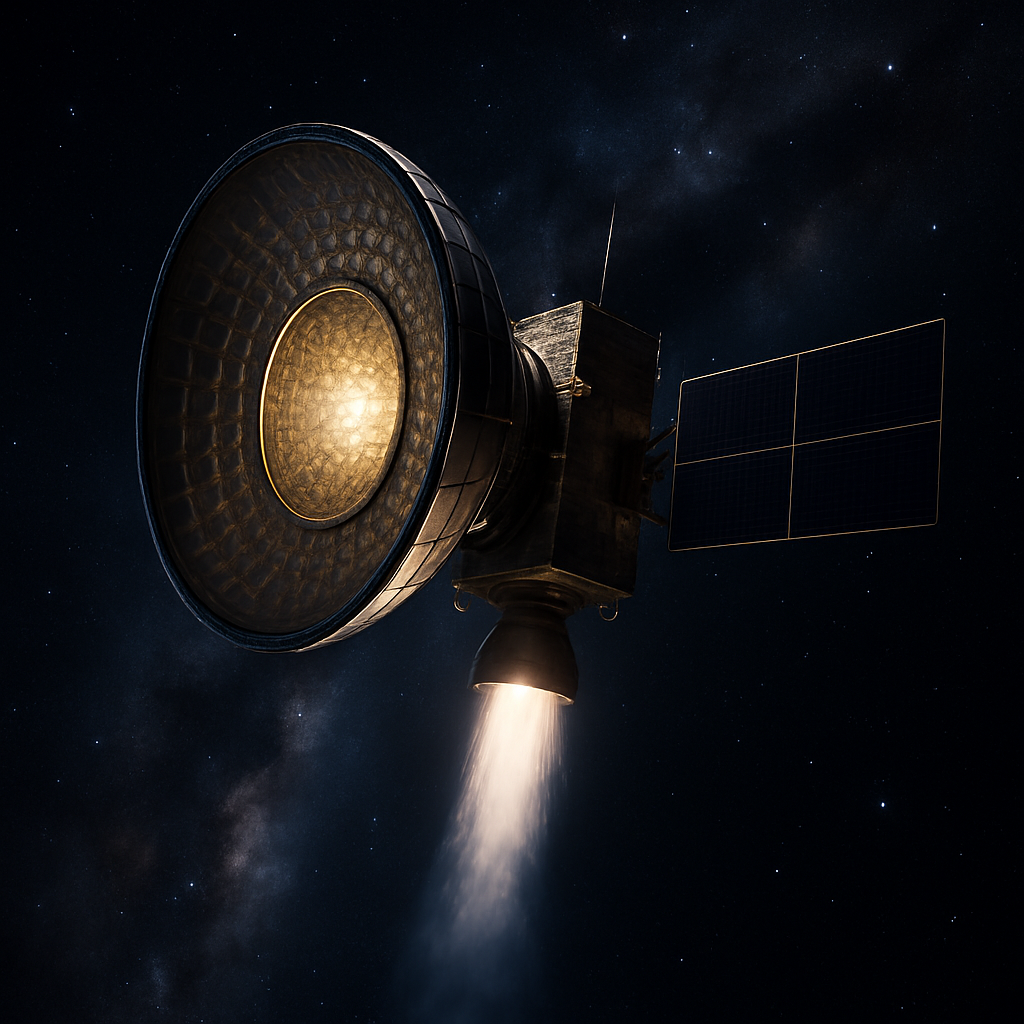
The world's first space-based neutrino detector reached orbital altitude in May 2026, marking a fundamental shift in how scientists observe some of the universe's most energetic events. The observatory will capture neutrinos -- ghostly particles that pass through virtually all matter -- from a vantage point no ground-based detector can match, opening a new channel for studying phenomena ranging from stellar explosions to the earliest moments after the Big Bang.
Neutrino detection has long been hamstrung by a core physics problem: these particles interact so weakly with matter that trillions stream through Earth every second without leaving a trace. Ground-based observatories have circumvented this by positioning massive detector arrays deep underground or beneath Antarctic ice sheets, where they're shielded from cosmic ray interference. The counterintuitive decision to place a detector in space exploits an entirely different detection principle -- one that leverages the orbital environment itself rather than fighting against it.
For decades, physicists debated whether space-based neutrino detection was feasible. Traditional detectors rely on rare collision events that produce observable secondary particles, a process that requires enormous mass and patience. Space-based alternatives use indirect methods: detecting the faint atmospheric effects of neutrino interactions or observing Cherenkov radiation signatures in novel materials designed for orbital conditions. This detector represents the first operational validation of these emerging techniques at scale.
The mission targets high-energy neutrinos from supernovae, active galactic nuclei, and gamma-ray bursts -- cosmic violence that ordinary light cannot fully reveal. A supernova's core, for example, converts 99 percent of its energy into neutrinos; the visible light is almost an afterthought. By capturing these messengers directly, the detector provides a computational window into stellar physics that spectroscopy and traditional astronomy cannot access. The instrument will operate continuously, feeding real-time data to ground stations that trigger alerts for simultaneous observations by other observatories.
The implications extend beyond astrophysics into fundamental particle theory. Neutrino oscillation -- the quantum phenomenon where neutrinos change flavor as they travel -- remains incompletely understood. Space-based observation distances and energy ranges offer new constraints on oscillation parameters and hints about physics beyond the Standard Model. Success here could reshape the hierarchy of particle detection methods and justify the cost of future space-based physics missions.
The detector's first months will be critical for validation. Engineering teams are confirming that orbital radiation, thermal cycling, and micrometeorite exposure haven't degraded sensor performance, and that data quality matches pre-launch simulations. If performance holds, the instrument is designed for a 10-year operational lifespan, potentially catching the neutrino signature of a nearby supernova -- an event that occurs in the Milky Way roughly once per century.
Watch for the release of first-light data in late 2026 and the detector's detection rate during the mission's commissioning phase. Any confirmed high-energy neutrino events will validate the space-based approach and likely trigger funding proposals for follow-on missions.